 Back
BackGeneral Biology Key Concepts
 09:50
09:50
Terms in this set (29)
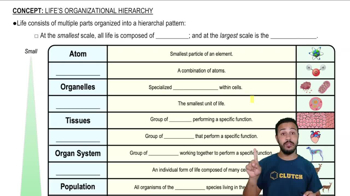
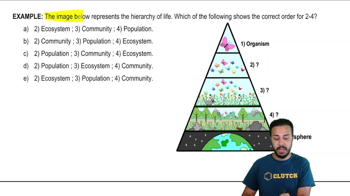
Order from largest to smallest: biosphere, ecosystem, community, population, organism, organ system, organ, tissue, cell, organelle, molecule.
Eukaryotic cells have a nucleus and membrane-bound organelles; prokaryotic cells lack a nucleus and membrane-bound organelles.
DNA is a double helix composed of nucleotides with a sugar-phosphate backbone and nitrogenous bases (A, T, C, G).
DNA is transcribed into mRNA, which is then translated by ribosomes to form a protein.
Energy flows through ecosystems (usually entering as light and exiting as heat), while matter cycles between organisms and the environment.
Evolution is the change in the genetic composition of a population over successive generations.
Bacteria, Archaea, and Eukarya are the three domains of life.
1) Species change over time; 2) Natural selection is the mechanism driving adaptation.
Observation, question, hypothesis, prediction, experiment, analysis, conclusion.
A hypothesis is a testable explanation; a prediction is a specific expected outcome derived from the hypothesis.
Independent variable is manipulated; dependent variable is measured.
Atoms consist of protons and neutrons in the nucleus, with electrons in shells around it.
Ionic bonds form by electron transfer; covalent bonds form by electron sharing.
Nonpolar covalent bonds share electrons equally; polar covalent bonds share electrons unequally.
Water is polar, forms hydrogen bonds, has high specific heat, cohesion, adhesion, and is a good solvent.
Carbohydrates, lipids, proteins, and nucleic acids.
Monomers are single units; polymers are chains of monomers linked together.
Polymers are formed by dehydration synthesis and broken down by hydrolysis.
Includes nuclear envelope, ER, Golgi apparatus, lysosomes, vacuoles, and plasma membrane.
Membrane allows some substances to pass while blocking others, maintaining cellular environment.
Describes the plasma membrane as a fluid lipid bilayer with embedded proteins forming a mosaic.
Passive transport requires no energy and moves substances down their concentration gradient; active transport requires energy to move substances against the gradient.
Energy cannot be created or destroyed, only transformed.
Entropy (disorder) of the universe increases over time.
Energy available to do work in a system, denoted as \(\Delta G\).
Exergonic reactions release energy; endergonic reactions require energy input.
Enzymes are biological catalysts that lower activation energy to speed up reactions.
Aerobic uses oxygen; anaerobic does not use oxygen for energy production.
Chlorophyll a is the primary photosynthetic pigment.