 Back
BackGeneral Biology Key Terms and Concepts
 09:26
09:26
Terms in this set (30)
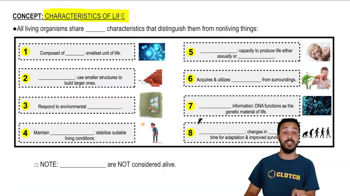
Homeostasis is the maintenance of a stable internal environment in an organism despite external changes.
A solute is a substance dissolved in a solvent to form a solution.
Maltose is a disaccharide sugar composed of two glucose units.
A catalyst speeds up a chemical reaction without being consumed.
Domain is the highest taxonomic rank, grouping organisms based on fundamental differences.
Hydrophilic molecules are attracted to water and can dissolve in it.
Ribose is a five-carbon sugar found in RNA.
A light microscope uses visible light to magnify small objects for viewing.
Kingdom is a major taxonomic category below domain grouping related phyla.
Hydrophobic molecules repel water and do not dissolve in it.
Deoxyribose is a sugar in DNA lacking one oxygen atom compared to ribose.
A scanning electron microscope produces detailed 3D images of specimen surfaces.
Phylum is a taxonomic rank below kingdom grouping related classes.
An acid is a substance that increases hydrogen ion concentration in solution.
Galactose is a monosaccharide sugar found in milk.
A transmission electron microscope passes electrons through thin samples to view internal structures.
Class is a taxonomic rank below phylum grouping related orders.
A base is a substance that reduces hydrogen ion concentration in solution.
Lactose is a disaccharide sugar made of glucose and galactose.
Cytosol is the fluid portion inside cells where organelles are suspended.
Order is a taxonomic rank below class grouping related families.
The pH scale measures acidity or alkalinity from 0 (acidic) to 14 (basic).
Sucrose is a common disaccharide made of glucose and fructose.
Peroxisomes are organelles that break down fatty acids and detoxify harmful substances.
Family is a taxonomic rank below order grouping related genera.
A buffer stabilizes pH by neutralizing added acids or bases.
Lipids are organic molecules including fats, oils, and steroids, important for energy storage and membranes.
Centrioles are cylindrical structures involved in cell division in animal cells.
Genus is a taxonomic rank below family grouping closely related species.
An organic molecule contains carbon atoms bonded to hydrogen, often forming the basis of life.