 Back
BackGeneral Biology: Microbial Life and Protists
 04:39
04:39
Terms in this set (31)
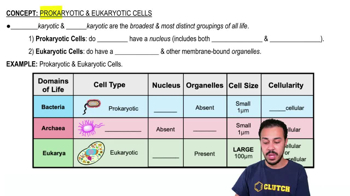
Prokaryotic (no nucleus) and Eukaryotic (has a nucleus).
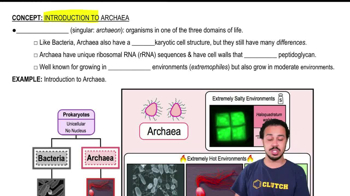
Bacteria and Archaea.
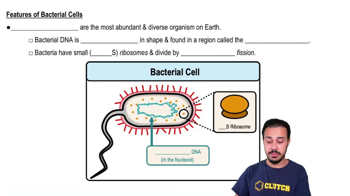
Circular DNA found in the nucleoid region (no membrane).
Prokaryotes have 70S ribosomes; eukaryotes have 80S ribosomes.
Prokaryotes divide by binary fission; eukaryotes divide by mitosis (or meiosis for sex cells).
Size (smaller vs. larger), nucleus (absent vs. present), organelles (absent vs. present), DNA shape (circular vs. linear), ribosome size (70S vs. 80S), cell division (binary fission vs. mitosis).
Archaea cell walls lack peptidoglycan, unlike most bacteria.
Organisms that thrive in extreme environments, such as very hot or salty conditions.
Prevents cell bursting by resisting internal osmotic pressure.
A rigid mesh-like polysaccharide and protein complex forming the main structure of bacterial cell walls.
Gram-positive have a thick peptidoglycan layer and no outer membrane; Gram-negative have a thin peptidoglycan layer plus an outer membrane.
Promotes cell attachment and protects from dehydration; important in biofilm formation.
Capsule is organized, dense, and tightly attached; slime layer is unorganized and loosely attached.
Cell motility (twitching/gliding) and DNA transfer via conjugation.
Fimbriae are shorter, more numerous, and function in adhesion; pili are longer and involved in motility and DNA transfer.
Dormant, highly resistant bacterial cells formed to survive harsh conditions.
No, binary fission is a prokaryotic asexual reproduction method only.
Transformation, Transduction, and Conjugation.
Uptake of free environmental DNA by a competent cell.
Direct DNA transfer between two bacterial cells via a pilus requiring donor and recipient.
A conjugative plasmid in E. coli that directs its own transfer during conjugation.
Energy source, electron source, and carbon source.
Phototrophs get energy from sunlight; chemotrophs get energy from chemical compounds.
Autotrophs fix CO₂ to make carbon molecules; heterotrophs consume organic molecules for carbon.
Obligate aerobes, facultative anaerobes, microaerophiles, obligate anaerobes, aerotolerant anaerobes.
A community of cells encased in a sticky polysaccharide matrix adhered to a surface.
Conversion of atmospheric N₂ into usable forms like NH₄ or NO₂ by prokaryotes.
The ability of a pathogen to produce toxins that damage host cells.
A diverse, paraphyletic group of eukaryotic organisms that are not plants, animals, or fungi.
A eukaryotic cell engulfing a prokaryotic cell, leading to organelles like mitochondria and chloroplasts.
A life cycle alternating between multicellular diploid (sporophyte) and haploid (gametophyte) forms.