 Back
BackGeneral Biology Midterm Study Guide
 01:35
01:35
Terms in this set (29)
Qualitative data describes qualities or characteristics, while quantitative data involves numerical measurements.
Inductive reasoning involves making generalizations based on specific observations.
Deductive reasoning starts with a general statement or hypothesis and examines possibilities to reach a specific conclusion.
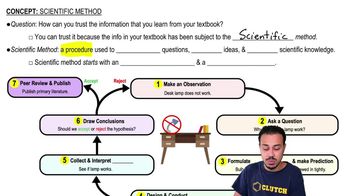
A hypothesis is a testable and falsifiable statement that explains a phenomenon or predicts an outcome.
A good hypothesis is testable, falsifiable, and based on prior knowledge or observations.
The experimental group is the group in an experiment that receives the treatment or independent variable.
The control group is the group that does not receive the treatment and is used for comparison.
A controlled experiment tests the effect of one variable by keeping all other variables constant.
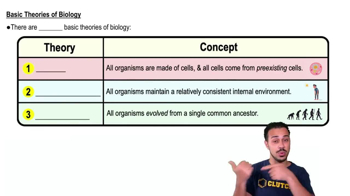
A scientific theory is a well-substantiated explanation based on a body of evidence from multiple experiments.
An element is a substance that cannot be broken down chemically. Essential elements are those required for life.
Atomic number is the number of protons; mass number is the sum of protons and neutrons in the nucleus.
Isotopes are atoms of the same element with different numbers of neutrons.
The valence shell is the outermost electron shell; valence electrons are electrons in this shell involved in bonding.
A chemical bond is an attraction that holds atoms together in molecules or compounds.
Covalent bonds share electrons, ionic bonds transfer electrons, and hydrogen bonds are weak attractions between polar molecules.
A polar covalent bond has unequal sharing of electrons due to differences in electronegativity; nonpolar shares electrons equally.
Electronegativity is an atom's ability to attract electrons in a chemical bond.
Chemical equilibrium occurs when the forward and reverse reaction rates are equal, stabilizing reactant and product concentrations.
Polar covalent bonds in water create partial charges that form hydrogen bonds between molecules.
Water's polarity allows it to dissolve many substances, making it a versatile solvent for biological reactions.
An acid increases hydrogen ion concentration; a base reduces hydrogen ion concentration in solution.
A buffer stabilizes pH by absorbing or releasing hydrogen ions as needed.
Organic chemistry studies carbon-containing compounds essential to life.
Carbon has four valence electrons allowing it to form four covalent bonds, creating diverse structures.
Isomers are molecules with the same molecular formula but different structures or spatial arrangements.
Functional groups are specific groups of atoms that confer characteristic properties to organic molecules.
Macromolecules are large molecules made of repeating units called polymers, which are built from monomers.
Carbohydrates, lipids, proteins, and nucleic acids are the four main biological macromolecules.
Monomers are monosaccharides for carbohydrates, amino acids for proteins, and nucleotides for nucleic acids.