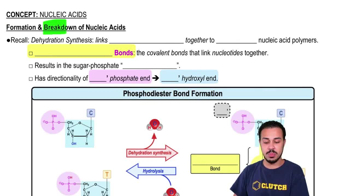
A nucleotide consists of a sugar (deoxyribose in DNA or ribose in RNA), a phosphate group, and a nitrogenous base.
Which nitrogenous bases are purines and which are pyrimidines?
Purines are adenine (A) and guanine (G) with a double ring structure; pyrimidines are thymine (T), cytosine (C), and uracil (U) with a single ring.
What base pairing rules apply in DNA and RNA?
In DNA, cytosine pairs with guanine, adenine pairs with thymine; in RNA, adenine pairs with uracil instead of thymine.
Describe the structure of DNA.
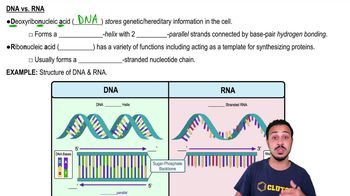
DNA is a double-stranded helix with antiparallel strands held together by complementary base pairing, with equal amounts of A and T, and G and C.
What does it mean that DNA strands are antiparallel?
One DNA strand runs 5’ to 3’ and the complementary strand runs 3’ to 5’, with the 3’ carbon attached to an OH group and the 5’ carbon attached to a phosphate group.
What is the semiconservative model of DNA replication?
Each daughter DNA molecule contains one original (parental) strand and one newly synthesized strand.
What is the role of DNA polymerase in replication?
DNA polymerase adds nucleotides to the 3’ end of a growing DNA strand, synthesizing new DNA in the 5’ to 3’ direction and proofreading for errors.
How are the leading and lagging strands synthesized during DNA replication?
The leading strand is synthesized continuously toward the replication fork; the lagging strand is synthesized in short Okazaki fragments away from the fork.
What is the function of DNA ligase?
DNA ligase joins Okazaki fragments on the lagging strand to form a continuous DNA strand.
What is the origin of replication?
The origin of replication is the specific site on the DNA where replication begins, creating replication bubbles that expand bidirectionally.
What are the three stages of transcription?
Initiation, elongation, and termination.
What is the role of RNA polymerase in transcription?
RNA polymerase binds to the promoter, unwinds DNA, and synthesizes RNA complementary to the DNA template strand.
What modifications occur during mRNA processing?
Addition of a 5’ cap, a 3’ poly-A tail, and removal of introns by RNA splicing to produce mature mRNA.
What is the difference between introns and exons?
Introns are noncoding sequences removed during RNA splicing; exons are coding sequences joined to form the final mRNA.
What is a codon?
A codon is a sequence of three nucleotides in mRNA that specifies a single amino acid.
What are the start and stop codons in translation?
The start codon is AUG (codes for methionine); stop codons are UAA, UAG, and UGA, signaling termination.
What is the role of tRNA in translation?
tRNA carries specific amino acids and has an anticodon that base-pairs with the mRNA codon to add amino acids to the growing polypeptide.
Describe the structure of a ribosome.
A ribosome has a small and large subunit composed of proteins and rRNA; it coordinates mRNA and tRNA during protein synthesis.
What are the three steps of elongation during translation?
Codon recognition, peptide bond formation, and translocation.
What is a mutation and what types affect protein coding?
A mutation is a change in genetic information; types include silent, missense, nonsense, and frameshift mutations.
What is the difference between an inducible and a repressible operon?
Inducible operons are usually off and can be turned on (e.g., lac operon); repressible operons are usually on and can be turned off (e.g., trp operon).
How does the lac operon function in E. coli?
The lac operon is turned on in the presence of lactose, which inactivates the repressor, allowing transcription of lactose metabolism genes.
What is X inactivation in female mammals?
One X chromosome is chemically modified and tightly packed into a Barr body, becoming mostly inactive to balance gene dosage.
What is epigenetic inheritance?
Inheritance of traits through chromatin modifications that do not change the DNA sequence and can be reversible.
What is the role of transcription factors in gene expression?
Transcription factors assist RNA polymerase by binding to promoters and enhancers to regulate gene transcription.
What is alternative RNA splicing?
A process where different combinations of exons are joined to produce multiple mRNA variants from a single gene.
What is the signal transduction pathway?
A series of molecular events where a signaling molecule binds a receptor, activating relay proteins that lead to gene expression changes.
What causes cancer at the molecular level?
Mutations in proto-oncogenes, tumor-suppressor genes, and faulty signal transduction pathways lead to uncontrolled cell growth.
What is PCR and its purpose?
Polymerase Chain Reaction (PCR) is a method to amplify DNA sequences, producing billions of copies in hours.
 Back
Back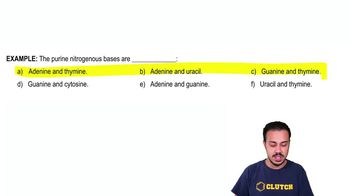
 01:05
01:05