 Back
BackGeneral Biology: Molecules of Cells
 03:35
03:35
Terms in this set (26)
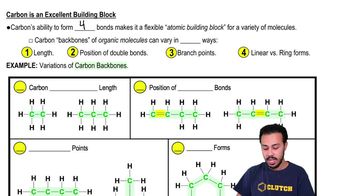
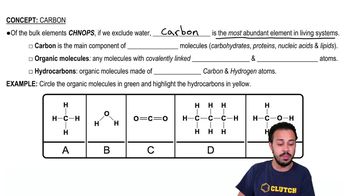
Carbon can form four covalent bonds, allowing it to build large, diverse organic molecules with various shapes and sizes.
Compounds with the same molecular formula but different structures and properties.
Organic molecules composed only of carbon and hydrogen, often found in fats and fuels.
Hydroxyl, Carbonyl, Carboxyl, Amino, Phosphate, and Methyl groups.
Consists of a hydrogen atom bonded to oxygen; makes molecules alcohols and increases solubility in water.
A carbon atom double bonded to oxygen; found in simple sugars like glucose and fructose.
A carbon double bonded to oxygen and bonded to a hydroxyl group; forms carboxylic acids and acts as an acid.
Contains nitrogen bonded to two hydrogens; found in amino acids, the building blocks of proteins.
Phosphorus bonded to four oxygens; involved in energy transfer molecules like ATP.
Carbon bonded to three hydrogens; can affect gene expression by modifying DNA or proteins.
By linking monomers into polymers through dehydration reactions and breaking them down by hydrolysis.
Simple sugar monomers like glucose, with a general formula multiple of \(C_H_2O\).
Two monosaccharides join by a dehydration reaction forming a glycosidic bond.
Long chains of monosaccharides; function as energy storage (starch, glycogen) or structural support (cellulose, chitin).
Diverse hydrophobic molecules mainly made of carbon and hydrogen; include fats, phospholipids, and steroids.
Triglycerides made of glycerol and three fatty acids; store long-term energy, insulate, and protect organs.
Saturated fats have no double bonds and are solid at room temperature; unsaturated fats have one or more double bonds and are liquid.
Unsaturated fats hydrogenated to be saturated; associated with increased heart disease risk.
Phospholipids form cell membranes; steroids include cholesterol and hormones like testosterone and estradiol.
Polymers of amino acids; function as enzymes, transporters, antibodies, hormones, receptors, contractile and structural components.
Central carbon bonded to an amino group, carboxyl group, hydrogen atom, and variable R group.
By peptide bonds formed in dehydration reactions between carboxyl and amino groups.
Primary: amino acid sequence; Secondary: local folding (alpha helices, beta sheets); Tertiary: 3D shape; Quaternary: multiple polypeptides.
DNA and RNA polymers made of nucleotide monomers composed of sugar, phosphate, and nitrogenous base.
DNA stores genetic information; RNA helps in protein synthesis and gene expression.
Mutations keep the lactase gene active in adults, allowing digestion of lactose in some populations.