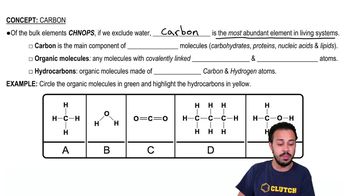
An organic compound is a carbon-based molecule essential for life, capable of forming large complex structures.
How many bonds can a carbon atom form and why?
Carbon has 4 valence electrons, allowing it to form up to 4 covalent bonds with other atoms.
What are isomers in organic chemistry?
Isomers are molecules with the same chemical formula but different arrangements, affecting their properties and functions.
What are functional groups and their importance?
Functional groups are specific chemical groups attached to carbon skeletons that affect molecule function by participating in chemical reactions.
What are macromolecules and how are they formed?
Macromolecules are large molecules formed by joining smaller molecules called monomers into polymers via dehydration synthesis.
What is dehydration synthesis?
A chemical reaction that joins two monomers by removing a water molecule (H₂O), forming a covalent bond.
What is hydrolysis in biological molecules?
Hydrolysis is the process of breaking polymers into monomers by adding water, reversing dehydration synthesis.
What are monosaccharides and their role?
Monosaccharides are simple sugar monomers like glucose, serving as the main fuel for cellular work and raw materials for other molecules.
How are disaccharides formed?
Disaccharides form when two monosaccharides join via dehydration synthesis, e.g., maltose from two glucose units.
What functions do polysaccharides serve?
Polysaccharides serve as energy storage (starch in plants, glycogen in animals) or structural components (cellulose, chitin).
What distinguishes starch and glycogen?
Both are glucose polymers; starch stores energy in plants, while glycogen stores energy in animals.
What is cellulose and its biological role?
Cellulose is a glucose polymer forming plant cell walls, providing structural support and is difficult to digest.
What are lipids and their key characteristics?
Lipids are hydrophobic molecules mainly of carbon and hydrogen, important for long-term energy storage and cell membranes.
What are the three main types of lipids?
Fats (triglycerides), phospholipids, and steroids are the three important lipid types.
What is the structure of a triglyceride?
A triglyceride consists of one glycerol molecule linked to three fatty acids via dehydration reactions.
How do saturated and unsaturated fats differ?
Saturated fats have no double bonds and are solid at room temperature; unsaturated fats have one or more double bonds causing kinks and are liquid.
What is the role of phospholipids in cells?
Phospholipids form the cell membrane bilayer, with hydrophilic heads and hydrophobic tails creating a selective barrier.
What defines steroids structurally?
Steroids have a carbon skeleton of four fused rings and include hormones like cholesterol, testosterone, and estradiol.
What are proteins and their general functions?
Proteins are polymers of amino acids involved in catalysis, transport, defense, signaling, structure, and storage.
What determines a protein's function?
A protein's function depends on its specific 3D shape, which is determined by its amino acid sequence.
What is a peptide bond?
A peptide bond is a covalent bond formed between amino acids by a dehydration reaction linking the carboxyl group of one to the amino group of another.
What are the four levels of protein structure?
Primary (amino acid sequence), secondary (alpha helices and beta sheets), tertiary (3D folding), and quaternary (multiple polypeptides).
What causes protein denaturation?
Denaturation occurs when a protein loses its shape and function due to changes in pH, salt concentration, or heat.
What are nucleic acids and their types?
Nucleic acids are polymers of nucleotides; DNA stores genetic information, and RNA helps synthesize proteins.
What are the components of a nucleotide?
A nucleotide consists of a five-carbon sugar (ribose or deoxyribose), a phosphate group, and a nitrogenous base.
What nitrogenous bases are found in DNA and RNA?
DNA has adenine (A), thymine (T), cytosine (C), guanine (G); RNA has adenine (A), uracil (U), cytosine (C), guanine (G).
How are DNA strands held together?
DNA strands form a double helix held by hydrogen bonds between complementary base pairs: A pairs with T, C pairs with G.
 Back
Back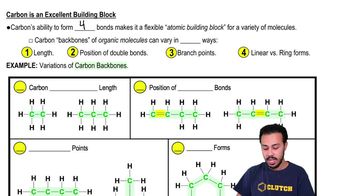
 03:35
03:35