Skip to main content
General Biology
My Course
Learn
Exam Prep
AI Tutor
Study Guides
Textbook Solutions
Flashcards
Explore
Try the app
My Course
Learn
Exam Prep
AI Tutor
Study Guides
Textbook Solutions
Flashcards
Explore
Try the app
Back
General Biology: Molecules, Water, and pH
You can tap to flip the card.
What are the two main categories of chemical compounds?
You can tap to flip the card.
👆
What are the two main categories of chemical compounds?
Inorganic
and
organic
compounds.
Track progress
Control buttons has been changed to "navigation" mode.
1/22
Recommended videos
02:00
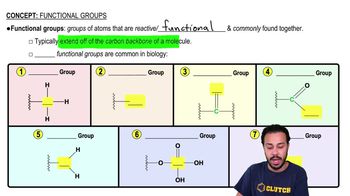
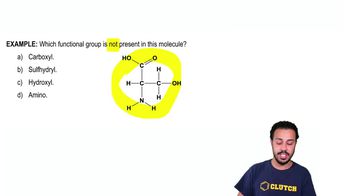
Functional Groups Example 1
19202
views
398
rank
1
comments
06:04
Functional Groups
27972
views
586
rank
1
comments
Terms in this set (22)
Hide definitions
What are the two main categories of chemical compounds?
Inorganic
and
organic
compounds.
What characterizes organic molecules?
Presence of
carbon (C)
and
carbon-hydrogen (C-H)
bonds forming the backbone.
How many covalent bonds can a carbon atom form and why?
Four covalent bonds because carbon has four valence electrons.
What elements commonly bond with carbon in organic molecules?
Hydrogen (H), oxygen (O), nitrogen (N), sulfur (S), and phosphorus (P).
What is a molecular formula?
A list of the types and numbers of atoms in a molecule without showing arrangement or bonds.
Rules for writing molecular formulas?
Write element symbols with subscripts for quantity; order: Carbon (C), Hydrogen (H), then others alphabetically.
What does a structural formula show?
Types and numbers of atoms plus every bond represented by lines (single or double).
What is an abbreviated structural formula?
A simplified structural formula omitting C-H bonds and grouping atoms in functional groups.
What do molecular models represent?
3-D representations of molecules using colored spheres for atoms and rods for bonds.
What colors represent carbon, hydrogen, oxygen, nitrogen, phosphorus, and sulfur in molecular models?
Carbon: black, Hydrogen: white, Oxygen: red, Nitrogen: blue, Phosphorus: purple, Sulfur: yellow.
What is an isomer?
Molecules with the same molecular formula but different structural arrangements.
Why is water essential for life?
It has unique physical properties like polarity, cohesion, adhesion, high specific heat, and ice floats.
What causes water's polarity?
Uneven sharing of electrons makes oxygen slightly negative and hydrogens slightly positive.
Define adhesion and cohesion in water.
Adhesion: water clings to other substances; Cohesion: water molecules bind together.
What is surface tension and why is it high in water?
Resistance to breaking the surface; high due to hydrogen bonding between water molecules.
What is capillary action?
Movement of water through narrow spaces against gravity via cohesion and adhesion.
What is pH?
A measure of hydrogen ion concentration indicating acidity or alkalinity on a scale from 0 to 14.
What pH values indicate acids, bases, and neutral solutions?
Acids: pH < 7, Bases: pH > 7, Neutral: pH = 7.
What does the logarithmic pH scale mean?
Each pH unit change represents a tenfold change in hydrogen ion concentration.
Why is pH regulation important in living organisms?
Maintains proper enzyme and protein function; e.g., human blood pH is tightly regulated around 7.35-7.45.
What is a buffer?
A mixture of weak acid and base that minimizes pH changes by releasing or binding H+ ions.
What is the function of buffers in living systems?
To maintain relatively stable pH despite addition of acids or bases.
 BackBack
 02:00