 Back
BackGeneral Biology: Muscle Structure and Function
 03:14
03:14
Terms in this set (22)
Skeletal muscle, cardiac muscle, and smooth muscle.
Striated, long fibers, multinucleated; responsible for voluntary movement; attached to bones.
Striated, branched, single nucleus, intercalated discs; involuntary rhythmic contractions; located in the heart.
Non-striated, spindle-shaped, single nucleus; controls involuntary movements like peristalsis; found in walls of hollow organs.
Muscle → muscle fascicle → muscle fiber (myocyte) → myofibril → sarcomere → myofilaments (myosin and actin).
The contractile unit within a myofibril, containing thick (myosin) and thin (actin) filaments.
Thin filament providing binding sites for myosin during contraction.
Thick filament with heads that bind to actin and pull to shorten the sarcomere.
Blocks myosin binding sites on actin to prevent contraction at rest.
Binds calcium ions and causes tropomyosin to move, exposing myosin binding sites on actin.
Bind to troponin, triggering tropomyosin to move and expose myosin binding sites on actin.
Provides energy for the myosin head power stroke and detachment from actin.
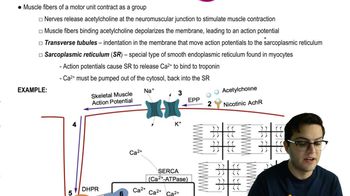
Action potential → acetylcholine release → muscle depolarization → Ca 2+ release → troponin binds Ca 2+ → tropomyosin moves → myosin binds actin → ATP hydrolysis → power stroke → cycle repeats.
Myosin heads attach to actin, pull (power stroke), detach, and reattach further along actin, shortening the sarcomere and causing contraction.
Ca 2+ is pumped back into the sarcoplasmic reticulum, tropomyosin blocks binding sites, and the muscle relaxes.
A single motor neuron and all the muscle fibers it controls.
Low innervation ratio: few muscle fibers per neuron for precise control (e.g., writing).
High innervation ratio: many muscle fibers per neuron for powerful contractions (e.g., lifting weights).
Increasing the number of active motor units to produce stronger muscle contractions.
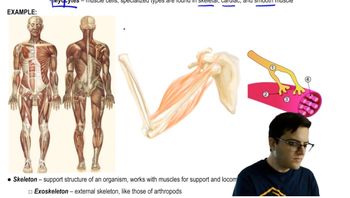
Pairs of muscles that work in opposition to move a joint, such as the biceps and triceps.
Bending a limb by decreasing the angle at a joint, e.g., biceps contract to flex the arm.
Straightening a limb by increasing the angle at a joint, e.g., triceps contract to extend the arm.