 Back
BackGeneral Biology: Plant Transport and Structure
 06:58
06:58
Terms in this set (14)
Phloem transports sugars (like sucrose) from sugar sources (e.g., leaves) to sugar sinks (e.g., roots or storage organs).
Xylem transports water and minerals from roots to the rest of the plant, supporting nutrient and water distribution.
High sugar concentration in source cells creates high water pressure, pushing sugar solution through phloem to low sugar concentration sink cells with lower pressure.
A sugar source is a plant part (like a leaf) where sugars are produced or released, typically by photosynthesis.
A sugar sink is a plant part (like roots or storage organs) that consumes or stores sugars transported from sources.
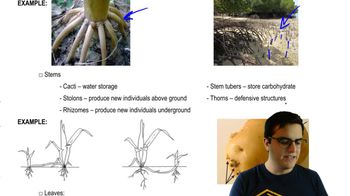
Root hairs increase surface area of roots, enhancing water absorption from the soil.
Transpiration is the evaporation of water from plant leaves, creating a pull that helps move water upward through xylem.
Guard cells regulate the opening and closing of stomata, controlling gas exchange and water loss.
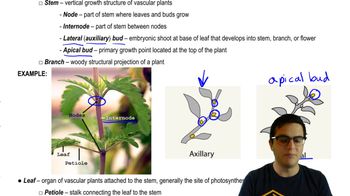
Apical meristems are regions of active cell division at root and shoot tips, enabling plant growth in length.
Parenchyma cells are thin-walled, totipotent cells capable of differentiating into various plant tissues.
Roots store sugars acting as sinks; when sugars are used, roots become sources, releasing sugars back to the plant.
Inorganic fertilizers provide readily available nutrients quickly, improving plant growth efficiency.
Micronutrients are essential elements required in small amounts for plant growth and development.
Carnivorous plants obtain minerals and nutrients by trapping and digesting insects, supplementing poor soil nutrients.