 Back
BackGeneral Biology: Population, Community, Ecosystems, and Evolution

 05:01
05:01
Terms in this set (30)
A group of individuals of the same species living in the same geographic area.
Number of individuals per unit area or volume.
Three types: Clumped (groups, most common), Uniform (evenly spaced), Random (unpredictable).
Number of individuals produced per unit time.
Number of individuals dying per unit time.
\(G = rN\), where G = individuals added, r = per capita growth rate, N = population size; produces a J-shaped curve.
The maximum population size an environment can support; produces a logistic (S-shaped) growth curve.
Factors whose effects increase as population density increases, e.g., disease, predation, competition, parasitism.
Factors affecting populations regardless of size, e.g., frost, fires, floods, hurricanes, droughts.
Low juvenile mortality, high mortality late in life; examples: humans, elephants.
Equal chance of dying at any age; example: songbirds.
Very high juvenile mortality, few survive to adulthood; examples: insects, many plants.
Produce many offspring, little parental care, reproduce early, short lifespan; examples: insects, weeds.
Few offspring, extensive parental care, longer lifespan; examples: humans, elephants.
All populations of different species living together in an area.
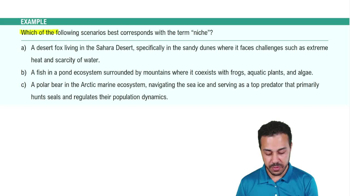
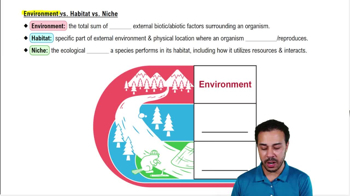
The role of a species in its environment, including food sources, habitat, resource use, and reproductive strategies.
Both organisms benefit (+/+); example: bees and flowers.
One benefits, other unaffected (+/0); example: barnacles on whales.
One benefits while harming the host (+/-); examples: ticks, tapeworms.
Species whose removal greatly changes an ecosystem; example: sea otters.
Includes biotic (living) and abiotic (nonliving) components like plants, animals, water, soil, and sunlight.
Organisms that make their own organic molecules; examples: plants, algae.
Obtain energy by eating other organisms.
Break down dead organisms and return nutrients; examples: bacteria, fungi.
Caused by excess nitrogen and phosphorus, leading to algal blooms, oxygen depletion, and fish kills.
Primarily temperature and precipitation.
Occurs where no previous community existed; pioneer species colonize first; examples: new volcanic rock.
Occurs where a community existed previously; examples: after forest fire or abandoned farmland.
Individuals produce more offspring than survive, compete for resources, and those with advantageous traits survive and reproduce.
\(p^2 + 2pq + q^2 = 1\), where p² = homozygous dominant, 2pq = heterozygous, q² = homozygous recessive.