 Back
BackGeneral Biology: Protists and Fungi
 03:23
03:23
Terms in this set (30)
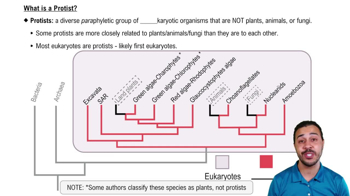
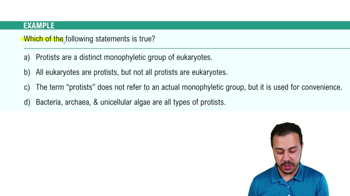
Protists are eukaryotes that are not plants, fungi, or animals, often unicellular with diverse structures and functions.
Protists have a nucleus, membrane-bound organelles, and a well-developed cytoskeleton, unlike prokaryotes.
They originated from endosymbiosis where bacteria were engulfed by early eukaryotes; plastids evolved from photosynthetic cyanobacteria.
It is when a eukaryote engulfs another eukaryote that already has plastids, evidenced by a vestigial nucleus called a nucleomorph.
Excavata: heterotrophic/mixotrophic; SAR: autotrophic, heterotrophic, parasitic; Archaeplastida: primarily autotrophic; Unikonta: heterotrophic.
Diplomonads have mitosomes, reduced mitochondria lacking electron transport chains, and cannot use oxygen for energy extraction.
They have hydrogenosomes that generate energy anaerobically and release hydrogen gas as a by-product.
Each flagellum contains a rod with a spiral or crystalline structure inside.
They have a single large mitochondrion with a DNA mass called a kinetoplast and include species that parasitize or feed on prokaryotes.
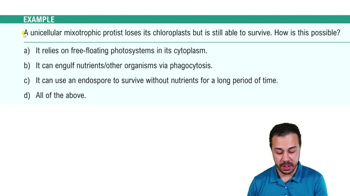
Euglenids perform photosynthesis when light is available and become heterotrophic by engulfing prey when it is not.
They have flagella with fine hairlike projections and include diatoms, brown algae, and oomycetes.
Diatoms have unicellular algae with a glass-like wall made of silicon dioxide.
They have analogous structures like holdfasts, stipes, and blades but lack true tissues and organs.
Oomycetes are water molds with cellulose cell walls and filamentous hyphae similar to fungi.
They have membrane-enclosed sacs called alveoli under the plasma membrane.
Blooms of dinoflagellates, some of which are photosynthetic phytoplankton, cause red tides.
They are mostly animal parasites with organelles specialized for penetrating host cells, including the malaria parasite.
Ciliates have both micronuclei for conjugation and macronuclei controlling daily cell functions.
Rhizarians are mostly amoebas that feed and move using threadlike pseudopodia.
Phycoerythrin allows red algae to absorb light at lower intensities, enabling deeper water photosynthesis.
Green algae include charophytes (closest to plants) and chlorophytes; plants likely evolved from charophytes.
Formation of colonies, true multicellular bodies by cell division and differentiation, and repeated nuclear division without cytoplasmic division.
It is the life cycle alternating between multicellular haploid gametophytes and diploid sporophytes producing spores.
Fungi are heterotrophs that absorb nutrients by secreting hydrolytic enzymes to break down organic matter externally.
Hyphae are tubular filaments forming a network called a mycelium, maximizing surface area for absorption.
Fungal cell walls are made of chitin, which strengthens the hyphae and aids absorption.
A fungal cell with two or more genetically distinct haploid nuclei sharing the same cytoplasm after plasmogamy.
Plasmogamy is the fusion of cytoplasm; karyogamy is the fusion of haploid nuclei to form diploid cells.
Mutualistic associations between fungi and plant roots where fungi improve mineral uptake and plants provide carbohydrates.
Symbiotic associations of fungi with algae or cyanobacteria, where fungi provide structure and algae provide carbon and nitrogen compounds.