Skip to main content
General Biology
My Course
Learn
Exam Prep
AI Tutor
Study Guides
Textbook Solutions
Flashcards
Explore
Try the app
My Course
Learn
Exam Prep
AI Tutor
Study Guides
Textbook Solutions
Flashcards
Explore
Try the app
Back
General Biology: The Cell Cycle
You can tap to flip the card.
What is the cell cycle?
You can tap to flip the card.
👆
What is the cell cycle?
The
cell cycle
is the series of events that cells go through as they grow and divide.
Track progress
Control buttons has been changed to "navigation" mode.
1/20
Recommended videos
Guided course
04:45
Asexual vs. Sexual Reproduction
16380
views
351
rank
3
comments
Guided course
09:40
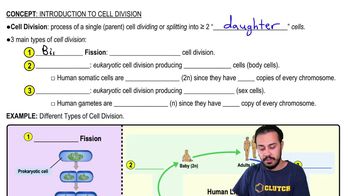
Introduction to Cell Division
25102
views
566
rank
1
comments
Guided course
03:19
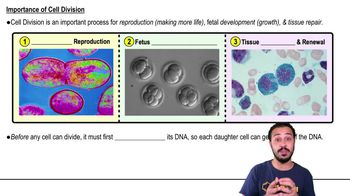
Importance of Cell Division
15573
views
492
rank
Terms in this set (20)
Hide definitions
What is the cell cycle?
The
cell cycle
is the series of events that cells go through as they grow and divide.
Name the main phases of the cell cycle.
The main phases are
interphase
(G1, S, G2) and
mitotic phase
(mitosis and cytokinesis).
What happens during the G1 phase?
In
G1 phase
, the cell grows and performs normal functions while preparing for DNA replication.
What occurs during the S phase?
During the
S phase
, the cell replicates its DNA, doubling its genetic material.
Describe the G2 phase.
In
G2 phase
, the cell continues to grow and prepares for mitosis by producing necessary proteins.
What is mitosis?
Mitosis
is the process where the cell's nucleus divides, distributing duplicated chromosomes into two daughter nuclei.
What is cytokinesis?
Cytokinesis
is the division of the cytoplasm, resulting in two separate daughter cells.
List the stages of mitosis in order.
Prophase, metaphase, anaphase,
and
telophase
.
What happens during prophase?
Chromosomes condense, the nuclear envelope breaks down, and the mitotic spindle begins to form.
Describe metaphase.
Chromosomes align at the cell's equator, attached to spindle fibers from opposite poles.
What occurs in anaphase?
Sister chromatids separate and move toward opposite poles of the cell.
Explain telophase.
Chromosomes decondense, nuclear envelopes reform around each set of chromosomes.
What controls the progression of the cell cycle?
The cell cycle is regulated by
checkpoints
and proteins like
cyclins
and
cyclin-dependent kinases (CDKs)
.
What is the function of the G1 checkpoint?
It checks for cell size, nutrients, growth factors, and DNA damage before allowing entry into S phase.
Why is the S phase checkpoint important?
It ensures DNA replication is complete and undamaged before the cell proceeds to G2.
What is the role of the M checkpoint?
It ensures all chromosomes are properly attached to the spindle before anaphase begins.
Define apoptosis in relation to the cell cycle.
Apoptosis
is programmed cell death that removes damaged or unneeded cells during the cell cycle.
How does cancer relate to the cell cycle?
Cancer results from uncontrolled cell division due to failures in cell cycle regulation.
What is the difference between mitosis and meiosis?
Mitosis produces two identical diploid cells; meiosis produces four genetically diverse haploid cells.
Why is DNA replication important before mitosis?
It ensures each daughter cell receives an identical set of chromosomes.
 BackBack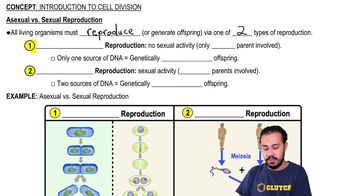
 04:45
04:45