Skip to main content
General Biology
My Course
Learn
Exam Prep
AI Tutor
Study Guides
Textbook Solutions
Flashcards
Explore
Try the app
My Course
Learn
Exam Prep
AI Tutor
Study Guides
Textbook Solutions
Flashcards
Explore
Try the app
Back
General Biology: Unifying Themes and Evolution
You can tap to flip the card.
What are the five unifying themes in biology?
You can tap to flip the card.
👆
What are the five unifying themes in biology?
Organization
,
Information
,
Energy and Matter
,
Interactions
, and
Evolution
.
Track progress
Control buttons has been changed to "navigation" mode.
1/20
Recommended videos
02:09
Unicellular vs. Multicellular
35851
views
1286
rank
2
comments
02:54
Introduction to Biology
56891
views
2092
rank
12
comments
1:28
Introduction to Biology Channel
66591
views
1683
rank
15
comments
Terms in this set (20)
Hide definitions
What are the five unifying themes in biology?
Organization
,
Information
,
Energy and Matter
,
Interactions
, and
Evolution
.
What is the smallest unit of life that can perform all activities required for life?
The
cell
is the smallest unit of organization that can perform all life activities.
What is the difference between prokaryotic and eukaryotic cells?
Prokaryotic cells
lack a nucleus and membrane-enclosed organelles;
eukaryotic cells
have a nucleus and membrane-enclosed organelles.
What is the basic structure of DNA?
DNA is made of two long chains arranged in a
double helix
, composed of nucleotides abbreviated A, G, C, and T.
What is gene expression?
Gene expression is the process where
DNA is transcribed into RNA
and then
translated into a protein
.
How does energy flow through an ecosystem?
Energy enters as
light
, is transformed by producers into chemical energy, passed to consumers, and exits as
heat
.
What is feedback regulation in biological systems?
Feedback regulation is when the output of a process regulates that process, commonly through
negative feedback
or
positive feedback
.
What are the three domains of life?
The three domains are
Bacteria
,
Archaea
(both prokaryotes), and
Eukarya
(eukaryotes).
What kingdoms are included in the domain Eukarya?
Eukarya includes
Plants
,
Fungi
,
Animals
, and
Protists
.
What is the core theme of evolution in biology?
Evolution explains the
unity and diversity
of life as living organisms are modified descendants of common ancestors.
What are the two main points of Darwin's theory of natural selection?
1. Species show
descent with modification
from common ancestors. 2.
Natural selection
is the mechanism driving this descent.
What observations did Darwin make about populations?
Individuals vary in heritable traits; more offspring are produced than survive; competition is inevitable; species suit their environment.
How does natural selection lead to evolution?
Individuals with advantageous traits survive and reproduce more, increasing those traits in the population over time.
What is the relationship between structure and function in biology?
At each biological level,
structure
provides clues about
function
, and knowing function helps understand structure.
What is the cell theory?
All living organisms are made of cells, and the cell is the basic unit of structure and function in life.
What role do genes play in inheritance?
Genes are units of inheritance that encode information for building molecules synthesized within the cell.
How do ecosystems cycle chemicals?
Chemicals cycle within ecosystems as they are used by organisms and then recycled back into the environment.
What is the difference between negative and positive feedback?
Negative feedback opposes a stimulus to maintain balance; positive feedback reinforces a stimulus to amplify a response.
Why do evolutionary relationships have a treelike form?
Because species descend from common ancestors and diverge over time, forming branching patterns of descent.
What is adaptive radiation as seen in Galápagos finches?
Adaptive radiation is when an ancestral species gives rise to multiple descendant species adapted to different environments.
 BackBack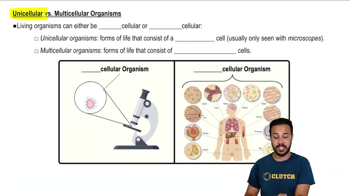
 02:09
02:09