Skip to main content
General Biology
My Course
Learn
Exam Prep
AI Tutor
Study Guides
Textbook Solutions
Flashcards
Explore
Try the app
My Course
Learn
Exam Prep
AI Tutor
Study Guides
Textbook Solutions
Flashcards
Explore
Try the app
Back
General Biology: Viruses
You can tap to flip the card.
What is a virus?
You can tap to flip the card.
👆
What is a virus?
A virus is a small infectious agent that requires a host cell to replicate, consisting of genetic material enclosed in a protein coat called a capsid.
Track progress
Control buttons has been changed to "navigation" mode.
1/21
Recommended videos
04:50
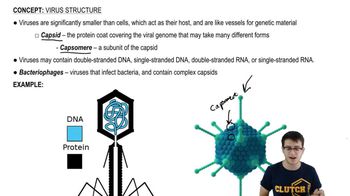
Virus Structure
7600
views
110
rank
1
comments
08:04
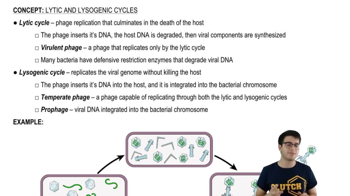
Lytic and Lysogenic Cycles
6504
views
55
rank
04:22
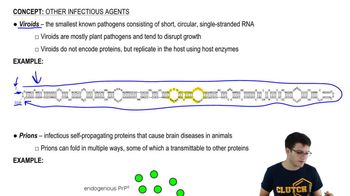
Viroids and Prions
4437
views
42
rank
Terms in this set (21)
Hide definitions
What is a virus?
A virus is a small infectious agent that requires a host cell to replicate, consisting of genetic material enclosed in a protein coat called a capsid.
What is a capsid?
The
capsid
is the protein coat that covers the viral genome and can take many different forms.
What is a capsomere?
A
capsomere
is a subunit of the capsid, the protein coat of a virus.
What types of genetic material can viruses have?
Viruses may contain double-stranded DNA, single-stranded DNA, double-stranded RNA, or single-stranded RNA.
What are bacteriophages?
Bacteriophages are viruses that infect bacteria and often have complex capsid structures.
What is a viral envelope?
A
viral envelope
is an accessory structure in many animal viruses, often derived from the host cell's membrane.
What determines a virus's host range?
The
host range
is the collection of hosts a virus can infect, determined by the virus's surface proteins binding to specific receptors on host cells.
How do viruses enter host cells?
Viruses enter host cells by injecting their genome, endocytosis, or membrane fusion.
What happens during viral replication?
The virus hijacks the host's machinery to produce viral nucleic acids and proteins, which assemble into new viruses.
What is the lytic cycle?
The lytic cycle is viral replication that ends with the host cell's death and release of new viruses.
What is a virulent phage?
A virulent phage replicates only by the lytic cycle, causing host cell destruction.
What is the lysogenic cycle?
The lysogenic cycle replicates viral DNA integrated into the host genome without killing the host.
What is a temperate phage?
A temperate phage can replicate via both the lytic and lysogenic cycles.
What is a prophage?
A prophage is viral DNA integrated into the bacterial chromosome during the lysogenic cycle.
How do animal viruses typically replicate?
Animal viruses often have envelopes and RNA genomes; they enter cells via receptor recognition and replicate using viral RNA polymerase.
What is a retrovirus?
A retrovirus has an RNA genome and uses reverse transcriptase to transcribe its RNA into DNA, which integrates into the host genome.
What is reverse transcriptase?
Reverse transcriptase is an enzyme that catalyzes the transcription of viral RNA into DNA.
What is a provirus?
A provirus is viral DNA integrated into the host's genome in animal cells.
How do double-stranded DNA viruses replicate?
They enter the nucleus and replicate their genomes often during the S phase of the host cell cycle.
What are viroids?
Viroids are small, circular, single-stranded RNA pathogens that infect plants and disrupt growth without encoding proteins.
What are prions?
Prions are infectious proteins that cause brain diseases by inducing misfolding of normal proteins.
 BackBack
 04:50