The Viridiplantae, or green plants, consist of green algae and land plants.
Why are green algae studied along with land plants?
Because green algae are the closest living relatives to land plants and land plants evolved from green algae during the transition from aquatic to terrestrial life.
What ecosystem services do green algae and land plants provide?
Producing oxygen via oxygenic photosynthesis, building soil by providing food for decomposers, holding soil and preventing nutrient loss, holding water in soil, and moderating local climate.
What role do land plants play in terrestrial ecosystems?
Land plants are the dominant primary producers, converting sunlight into chemical energy and supporting virtually all other terrestrial organisms.
How do land plants impact the carbon cycle?
They take CO2 from the atmosphere and reduce it to make sugars, fixing more CO2 than they release, thus influencing global climate.
What are the three major groups of land plants based on morphology?
Nonvascular plants (lack vascular tissue, use spores), seedless vascular plants (have vascular tissue, use spores), and seed plants (have vascular tissue, produce seeds).
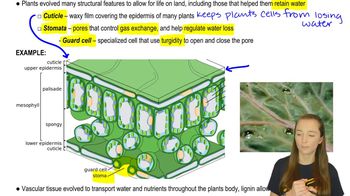
What is the function of the cuticle in land plants?
A waxy layer that prevents water loss from stems and leaves, helping plants resist drying.
How do stomata help plants adapt to terrestrial life?
Stomata are pores that allow gas exchange in photosynthetic tissues while minimizing water loss.
What adaptations protect plants from UV radiation?
Plants accumulate UV-absorbing compounds like flavonoids that protect DNA from UV damage.
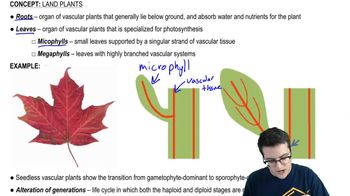
What is the significance of vascular tissue in plants?
Vascular tissue, containing lignin, provides structural support and allows efficient water transport, enabling upright growth.
What are the three key reproductive innovations for plants in dry environments?
Spores resistant to drying (sporopollenin coat), gametes produced in multicellular structures, and embryos retained and nourished by the parent plant.
What is alternation of generations in land plants?
A life cycle with multicellular haploid gametophyte and multicellular diploid sporophyte phases connected by gametes and spores.
How do spores and gametes differ in plants?
Spores are haploid cells produced by meiosis that develop into gametophytes; gametes are haploid cells produced by mitosis that fuse to form a diploid zygote.
What is the difference between gametophyte-dominant and sporophyte-dominant life cycles?
Nonvascular plants have gametophyte-dominant cycles; vascular plants have sporophyte-dominant cycles where sporophytes are larger and longer-lived.
What is pollen and why is it important?
Pollen grains are tiny male gametophytes with a tough coat that allow plants to reproduce efficiently in dry habitats.
What defines a seed in plants?
A seed contains an embryo, nutritive tissue, and a protective coat, enabling better survival and dispersal than spores.
How do flowers increase pollination efficiency?
Flowers attract specific pollinators by providing food and rewards, increasing the probability of pollen transfer between individuals.
What is the directed-pollination hypothesis?
Natural selection favors flower structures that reward animals for carrying pollen directly from one flower to another.
What is a fruit in angiosperms?
A fruit is a structure derived from the ovary that encloses one or more seeds.
What are some key similarities between green algae and land plants?
Similar chloroplast structure, thylakoid arrangement, cell walls, sperm, peroxisomes, and starch synthesis.
Which green algae groups are most closely related to land plants?
Zygnematophyceae, Coleochaetophyceae, and Charophyceae.
What are the two key synapomorphies of seed plants?
Production of seeds and production of pollen grains.
How do gymnosperms and angiosperms differ in seed production?
Angiosperms produce seeds in ovaries; gymnosperms produce 'naked' seeds not enclosed in ovaries.
Why are plants essential for human medicine?
About 25% of prescriptions include molecules derived from plants, many synthesized to repel herbivores.
 Back
Back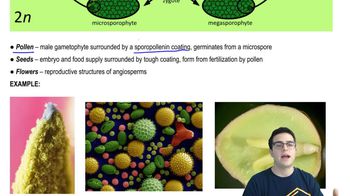
 06:17
06:17