 Back
BackKey Concepts
 02:09
02:09

Terms in this set (20)
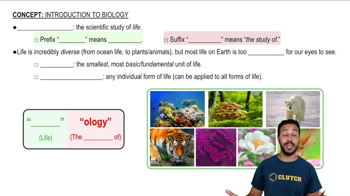
Biology is the scientific study of life, characterized by properties such as order, reproduction, growth, energy processing, regulation, response to the environment, and evolutionary adaptation.
Order, reproduction, growth and development, energy processing, regulation, response to the environment, and evolutionary adaptation.
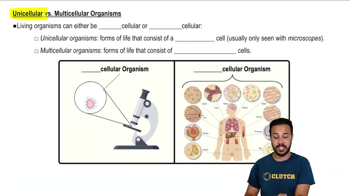
The cell is the fundamental structural and functional unit of life.
Life is classified into three domains: Bacteria, Archaea (both with simple cells), and Eukarya (including protists and kingdoms Fungi, Plantae, and Animalia).
Emergent properties arise from the specific arrangement and interactions of parts at each level of biological organization.
Atoms, molecules, organelles, cells, tissues, organs, organ systems, organisms, populations, communities, ecosystems, biosphere.
A process involving observation, hypothesis formation, prediction, experimentation or further observation, and data analysis to understand natural phenomena.
The independent variable is manipulated; the dependent variable is measured and depends on the independent variable.
An experiment comparing an experimental group with a control group to test the effect of a single variable.
Evolution is the core theme, explaining the unity and diversity of life through natural selection and descent with modification.
Evolutionary theory informs medicine, conservation, agriculture, and explains artificial selection in crops and livestock.
DNA stores hereditary information and programs cellular activities by encoding proteins.
At all levels, the structure of a biological component correlates with its function, e.g., protein shape determines its role.
Energy flows one way: sunlight → producers → consumers → heat loss.
Matter cycles between the atmosphere, soil, producers, consumers, decomposers, and back to the environment.
An approach to model biological systems by analyzing interactions among their parts to understand emergent properties.
Bacteria, Archaea, and Eukarya.
Protists, Fungi, Plantae, and Animalia.
Domain, Kingdom, Phylum, Class, Order, Family, Genus, Species.
A scientific theory is a broad explanation supported by a large body of evidence.