Skip to main content
General Biology
My Course
Learn
Exam Prep
AI Tutor
Study Guides
Textbook Solutions
Flashcards
Explore
Try the app
My Course
Learn
Exam Prep
AI Tutor
Study Guides
Textbook Solutions
Flashcards
Explore
Try the app
Back
Membrane Structure and Function
You can tap to flip the card.
What is the fluid mosaic model of cellular membranes?
You can tap to flip the card.
👆
What is the fluid mosaic model of cellular membranes?
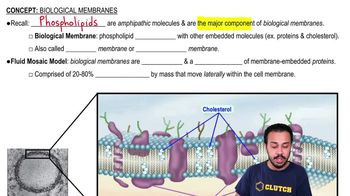
Cellular membranes are fluid mosaics of lipids and proteins, mainly phospholipids arranged in a bilayer with embedded proteins.
Track progress
Control buttons has been changed to "navigation" mode.
1/25
Recommended videos
02:21
Biological Membranes Example 1
24681
views
457
rank
1
comments
06:04
Biological Membranes
33827
views
687
rank
2
comments
Terms in this set (25)
Hide definitions
What is the fluid mosaic model of cellular membranes?
Cellular membranes are fluid mosaics of lipids and proteins, mainly phospholipids arranged in a bilayer with embedded proteins.
What are phospholipids and their key property in membranes?
Phospholipids are amphipathic molecules with hydrophilic heads and hydrophobic tails, forming the plasma membrane bilayer.
What does freeze-fracture technique reveal about membranes?
Freeze-fracture splits membranes along the phospholipid bilayer, supporting the fluid mosaic model by showing protein distribution.
How do phospholipids move within the membrane?
Phospholipids exhibit lateral movement (~10^7 times per second) and rare flip-flop movement across the bilayer.
How does temperature affect membrane fluidity?
Membranes switch from fluid to solid state as temperature cools; fluidity depends on lipid types like saturated or unsaturated tails.
What role does cholesterol play in membrane fluidity?
Cholesterol modulates fluidity by preventing tight packing at low temperatures and restraining movement at high temperatures.
List six major functions of membrane proteins.
Transport, enzymatic activity, signal transduction, cell-cell recognition, intercellular joining, and attachment to cytoskeleton/ECM.
How do membrane carbohydrates contribute to cell recognition?
Carbohydrates covalently bonded to lipids (glycolipids) or proteins (glycoproteins) enable cells to recognize each other.
What is selective permeability of membranes?
Membranes regulate molecular traffic, allowing hydrophobic molecules to pass easily but restricting polar molecules.
What are transport proteins and their types?
Transport proteins facilitate hydrophilic molecule passage; types include channel proteins (e.g., aquaporins) and carrier proteins.
Define passive transport and diffusion.
Passive transport is diffusion across membranes without energy; diffusion is molecules spreading evenly in available space.
What is osmosis?
Osmosis is the diffusion of water across a selectively permeable membrane from low to high solute concentration.
Explain tonicity and its effects on cells.
Tonicity describes solution's effect on cell water balance: isotonic (no change), hypertonic (cell loses water), hypotonic (cell gains water).
What is facilitated diffusion?
Facilitated diffusion uses transport proteins to speed passive movement of molecules across membranes without energy.
What is active transport?
Active transport moves substances against concentration gradients using energy, usually ATP, via specific membrane proteins.
Describe the sodium-potassium pump.
An active transport system exchanging 3 Na+ out and 2 K+ into the cell, maintaining concentration gradients and membrane potential.
What is membrane potential?
Membrane potential is the voltage difference across a membrane caused by ion distribution differences.
What forces drive ion diffusion across membranes?
The electrochemical gradient combines chemical concentration gradient and electrical membrane potential forces.
What is an electrogenic pump?
A transport protein that generates voltage across a membrane, e.g., sodium-potassium pump in animals or proton pump in plants.
What is cotransport?
Cotransport is coupled transport where a membrane protein moves two substances simultaneously, often using a gradient.
What are exocytosis and endocytosis?
Bulk transport processes where cells export materials via vesicles (exocytosis) or import via vesicle formation (endocytosis).
Name three types of endocytosis.
Phagocytosis (cell eating), pinocytosis (cell drinking), and receptor-mediated endocytosis (ligand-specific uptake).
How does phagocytosis work?
A cell engulfs particles into a vacuole that fuses with lysosomes for digestion.
What happens during pinocytosis?
Extracellular fluid is 'gulped' into tiny vesicles for nonspecific uptake of molecules.
Explain receptor-mediated endocytosis.
Specific ligands bind receptors triggering vesicle formation to selectively import molecules.
 BackBack
 02:21