Skip to main content
General Biology
My Course
Learn
Exam Prep
AI Tutor
Study Guides
Textbook Solutions
Flashcards
Explore
Try the app
My Course
Learn
Exam Prep
AI Tutor
Study Guides
Textbook Solutions
Flashcards
Explore
Try the app
Back
Membrane Structure and Function - Lecture 4a-chapter 7-(page 1-36)(exam 2)
You can tap to flip the card.
What are the main components of cellular membranes?
You can tap to flip the card.
👆
What are the main components of cellular membranes?
Lipids
and
proteins
are the main components, with carbohydrates also playing an important role.
Track progress
Control buttons has been changed to "navigation" mode.
1/20
Recommended videos
02:21
Biological Membranes Example 1
24678
views
457
rank
1
comments
06:04
Biological Membranes
33821
views
687
rank
2
comments
Terms in this set (20)
Hide definitions
What are the main components of cellular membranes?
Lipids
and
proteins
are the main components, with carbohydrates also playing an important role.
What is the structure of phospholipids in membranes?
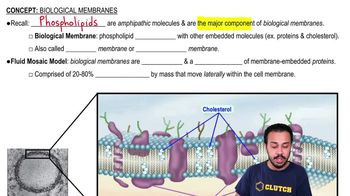
Phospholipids are
amphipathic
molecules with hydrophilic heads and hydrophobic tails, forming a bilayer.
Describe the fluid mosaic model of membrane structure.
Membranes are a mosaic of protein molecules bobbing in a fluid bilayer of phospholipids, with proteins often grouped by function.
How do temperature and lipid composition affect membrane fluidity?
Membranes rich in
unsaturated fatty acids
are more fluid; cooling causes membranes to solidify depending on lipid types.
What role does cholesterol play in membrane fluidity?
Cholesterol reduces fluidity at moderate temperatures and prevents solidification at low temperatures by disrupting packing.
What are the two major types of membrane proteins?
Peripheral proteins
are bound to the membrane surface;
integral proteins
penetrate the hydrophobic core.
What are transmembrane proteins?
Integral proteins that span the entire membrane, often with hydrophobic α helices embedded in the bilayer.
List six functions of cell-surface membrane proteins.
Transport, enzymatic activity, signal transduction, cell-cell recognition, intercellular joining, and attachment to cytoskeleton/ECM.
How do membrane carbohydrates contribute to cell recognition?
Carbohydrates bonded to lipids (glycolipids) or proteins (glycoproteins) serve as diverse markers for cell identification.
What is selective permeability in membranes?
Membranes allow some substances to cross more easily than others, regulating molecular traffic.
How do hydrophobic and hydrophilic molecules cross the lipid bilayer?
Hydrophobic molecules pass rapidly through the bilayer; hydrophilic molecules cross slowly or require transport proteins.
What are the two types of transport proteins?
Channel proteins
provide hydrophilic tunnels;
carrier proteins
bind and shuttle molecules across membranes.
What is the function of aquaporins?
Aquaporins are channel proteins that greatly increase water molecule passage through membranes.
Define diffusion in the context of membranes.
Diffusion is the movement of particles spreading evenly, moving down their concentration gradient without energy input.
What is passive transport?
The diffusion of substances across membranes without energy expenditure, driven by concentration gradients.
Explain osmosis.
Osmosis is the diffusion of free water across a selectively permeable membrane from low to high solute concentration.
What is tonicity and how does it affect cells without cell walls?
Tonicity is the ability of a solution to cause water movement; it affects cell volume by water gain or loss.
What happens to a cell in an isotonic solution?
Water diffuses equally in both directions; cell volume remains stable.
What happens to a cell in a hypertonic solution?
Water leaves the cell, causing it to shrivel and possibly die.
What happens to a cell in a hypotonic solution?
Water enters the cell, causing it to swell and potentially burst (lyse).
 BackBack
 02:21