 Back
BackMendelian Genetics and Inheritance Patterns
 01:58
01:58
Terms in this set (18)
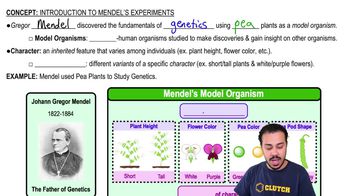
Traits are observable characteristics inherited from parents, such as eye color, height, blood type, and disease susceptibility, coded by genes in DNA sequences.
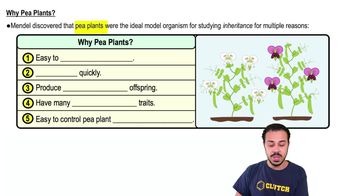
Pea plants have distinct, easily observable traits, can self-fertilize or cross-fertilize, and produce many offspring quickly, making them ideal for studying inheritance.
Self-fertilization uses pollen from the same plant; cross-fertilization uses pollen from a different plant, allowing controlled breeding experiments.
All F1 offspring had purple flowers, showing the purple trait is dominant over white.
The F2 generation showed a consistent 3:1 ratio of dominant to recessive traits.
Two alleles for a trait separate during gamete formation, so each gamete carries only one allele.
Homozygous: two identical alleles; heterozygous: two different alleles. Dominant allele determines phenotype in heterozygotes.
Alleles differ in DNA sequence, producing different proteins that affect biochemical pathways, resulting in alternative traits.
Inheritance pattern where heterozygotes show an intermediate phenotype between the two homozygotes.
Two alleles affect the phenotype in separate, distinguishable ways, such as the human MN blood group.
More than two alleles exist for a gene in a population, e.g., ABO blood groups with alleles IA, IB, and i.
When a gene at one locus alters the phenotypic expression of a gene at a second locus, such as coat color in mammals.
Genes are located on chromosomes, which segregate and assort independently during meiosis, explaining Mendelian inheritance.
Males have only one allele for X-linked genes (on their single X chromosome), so recessive traits are more common in males.
More common in males; females can be carriers. Affected males inherit the allele from their mother.
Failure of chromosome pairs to separate during meiosis, causing aneuploidy such as Turner syndrome (X), Klinefelter syndrome (XXY), and others.
Dominant traits are expressed in heterozygotes; recessive traits are masked unless homozygous.
Alleles of different genes separate independently during gamete formation, leading to genetic variation.