 Back
BackMendelian Genetics and Inheritance Patterns
 02:09
02:09
Terms in this set (25)
Heredity is the transmission of traits from one generation to the next.
A character is a heritable feature that varies among individuals, and a trait is a variant of that character.
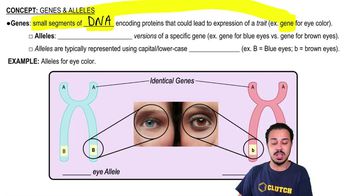
Alleles are alternative versions of genes that determine heritable traits.
A true-breeding plant is one that, when self-fertilized, produces offspring with the same trait for many generations.
The P generation refers to the true-breeding parental plants used in Mendel's crosses.
A monohybrid cross is a cross between two individuals differing in a single character.
Allele pairs separate during gamete formation, so each gamete carries only one allele for each character.
Genotype is the genetic makeup (allele combination), while phenotype is the physical expression of a trait.
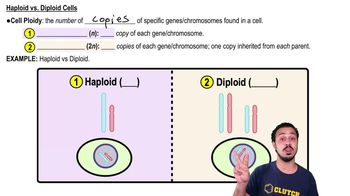
Homozygous individuals have two identical alleles; heterozygous individuals have two different alleles for a character.
Dominant alleles determine the organism's appearance with one copy; recessive alleles have no effect unless two copies are present.
A Punnett square is a diagram used to predict the possible allele combinations from a genetic cross.
A dihybrid cross follows the inheritance of two different characters simultaneously.
Alleles for different genes assort independently during gamete formation, leading to random combinations.
The typical phenotypic ratio is \(9:3:3:1\) for the F2 generation.
A testcross is a mating between an individual with an unknown genotype and a homozygous recessive individual to determine the unknown genotype.
Probability predicts the likelihood of specific genotypes or phenotypes occurring in offspring based on allele combinations.
Incomplete dominance occurs when the heterozygote's phenotype is intermediate between the two homozygotes.
Codominance occurs when both alleles in a heterozygote are fully expressed separately.
Three alleles (IA, IB, and i) control ABO blood type, with IA and IB codominant and both dominant over i.
Pleiotropy occurs when one gene influences multiple phenotypic traits, such as the hemoglobin gene in sickle-cell disease.
Polygenic inheritance is when multiple genes contribute additively to a single phenotypic character, producing a range of phenotypes.
Linked genes are located close together on the same chromosome and tend to be inherited together, violating independent assortment.
Crossing over during meiosis can separate linked genes, producing recombinant gametes with new allele combinations.
Sex-linked genes are genes located on sex chromosomes, often showing unique inheritance patterns, such as X-linked recessive traits.
Males have only one X chromosome, so a single recessive allele causes the disorder; females need two copies to be affected.