 Back
BackOsmoregulation and Excretion in General Biology
 06:25
06:25
Terms in this set (20)
Osmoregulation is the control of water and solute balance in the body to maintain homeostasis.
Excretion is the secretion of metabolic wastes, especially nitrogenous wastes, from the body.
Terrestrial organisms need to conserve water and also excrete water-soluble toxic metabolic wastes, requiring specialized osmoregulation and excretion mechanisms.
Kidneys function in osmoregulation and excretion by creating an osmolarity gradient and selectively reabsorbing water and ions.
Osmolarity measures osmotic pressure in mOsm/L: freshwater ~0-20, blood ~300, seawater ~1000.
Osmoconformers have body fluids isoosmotic with their environment; osmoregulators actively regulate their body fluid osmolarity.
Marine fish lose water by osmosis, drink seawater, and actively excrete ions via gills and kidneys.
Freshwater fish gain water by osmosis, excrete large amounts of dilute urine, and actively uptake ions from food and kidneys.
Anhydrobiosis is a dormant state allowing some animals to survive extreme dehydration by losing almost all body water.
Most aquatic animals excrete ammonia (NH3) because it is highly toxic but highly soluble and can diffuse away in water.
Mammals and many vertebrates convert ammonia to urea, which is less toxic and can be concentrated to conserve water.
Reptiles and birds excrete uric acid, which is non-soluble, precipitates as a solid, and requires very little water but is costly to produce.
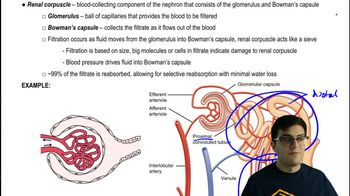
1. Filtration, 2. Reabsorption, 3. Secretion, 4. Excretion of urine.
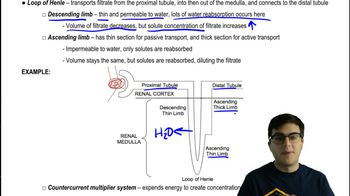
The nephron is the functional unit, consisting of Bowman’s capsule, proximal tubule, loop of Henle, distal tubule, and collecting duct.
Active reabsorption of ions and water occurs, concentrating wastes in the filtrate.
It is permeable to water but not salts, allowing water reabsorption and further concentration of filtrate.
It is permeable to NaCl but not water, allowing active reabsorption of salts and dilution of filtrate.
The collecting duct reabsorbs water and NaCl under hormonal control, concentrating urine as it moves down the osmolarity gradient.
Antidiuretic hormone (ADH) increases water permeability in distal tubules and collecting ducts, concentrating urine and lowering blood osmolarity.
RAAS maintains blood pressure by initiating vasoconstriction and increasing sodium and water reabsorption when blood pressure is low.