 Back
BackPhotosynthesis Basics - General Biology
 03:32
03:32
Terms in this set (20)
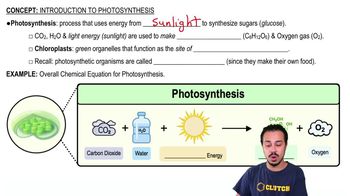
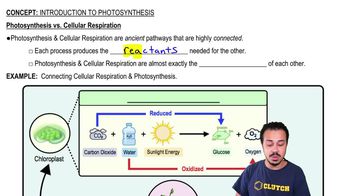
Photosynthesis is the process by which green plants, algae, and some bacteria convert light energy into chemical energy stored in glucose.
Photosynthesis occurs in the chloroplasts of plant cells.
The two main stages are the light-dependent reactions and the Calvin cycle (light-independent reactions).
Chlorophyll is the primary pigment that absorbs light energy for photosynthesis.
Light energy, water (H2O), NADP+, and ADP + Pi are the main inputs.
Oxygen (O2), ATP, and NADPH are produced in the light-dependent reactions.
Water is split (photolysis) to release oxygen, electrons, and protons during the light-dependent reactions.
ATP and NADPH provide energy and reducing power for the Calvin cycle to synthesize glucose.
The Calvin cycle is the light-independent stage where CO2 is fixed into glucose using ATP and NADPH.
Rubisco is the enzyme that catalyzes CO2 fixation in the Calvin cycle.
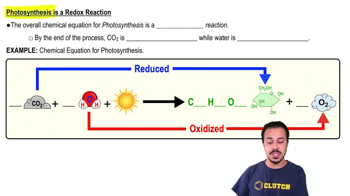
6 CO2 + 6 H2O + light energy → C6H12O6 + 6 O2
Photosynthesis produces oxygen and organic molecules that are essential for most life forms.
Blue and red wavelengths are most effectively absorbed by chlorophyll for photosynthesis.
Photophosphorylation is the process of generating ATP from ADP and Pi using light energy during the light-dependent reactions.
The electron transport chain transfers electrons to produce ATP and NADPH during the light-dependent reactions.
Oxygen is released from the splitting of water molecules during the light-dependent reactions.
The Calvin cycle regenerates ribulose bisphosphate (RuBP) to continue fixing CO2.
NADP+ acts as an electron carrier, becoming NADPH after accepting electrons in the light-dependent reactions.
C3 plants fix CO2 directly via the Calvin cycle; C4 plants use a separate pathway to concentrate CO2 and reduce photorespiration.
Increasing light intensity increases the rate of photosynthesis up to a point, after which it plateaus.