 Back
BackPlant Structure, Growth, and Reproduction
 06:58
06:58
Terms in this set (32)
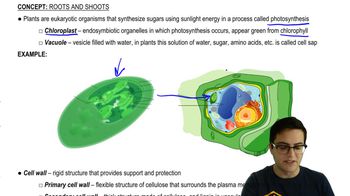
Flexible cellulose structure surrounding the plasma membrane during cell growth.
Thick cellulose and lignin structure formed after cell growth, providing rigidity.
Polymer in vascular plants that strengthens cell walls and is a key component of wood.
Channels between plant cells allowing transport and cell signaling.
Anchors plant, absorbs water and ions, stores materials produced in shoots.
Largest dominant root from which lateral roots project.
Gathers CO2 and light and carries out photosynthesis.
Includes petiole (stalk), blade (main part), mesophyll (photosynthetic tissue), and stomata (pores for gas exchange).
Specialized cells that regulate stomata opening by changing turgidity.
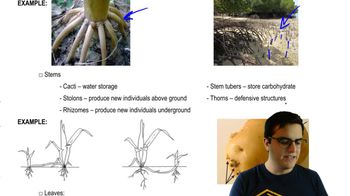
Plants change form based on environment, e.g., prop roots for support, pneumatophores for gas exchange.
Conducts water and dissolved nutrients from roots to shoots.
Tracheids are long, thin water-conducting cells; vessel elements are short, wide cells with perforations for efficient water flow.
Transports sugars, amino acids, and signals between roots and shoots.
Specialized phloem cells with sieve plates that facilitate nutrient transport.
Support sieve tube elements metabolically and physically.
Waxy film secreted by epidermal cells to prevent water loss and protect against pathogens.
Hair-like epidermal structures that prevent water loss, defend herbivores, and reflect sunlight.
Most abundant plant cells, totipotent, form pith, cortex, and mesophyll, aid healing and reproduction.
Provide flexible structural support in growing shoots and leaves with thick primary walls.
Provide rigid support, dead at maturity, with thick lignin-rich secondary walls.
Growth in length from apical meristems at root and shoot tips.
Group of stem cells at root or shoot tips producing new cells for growth.
Includes cell division, elongation, and maturation zones with root hairs for absorption.
Growth in thickness from lateral meristems like vascular cambium and cork cambium.
Lateral meristem producing secondary xylem (inside) and phloem (outside).
Derived from secondary xylem; heartwood is inner, dark, decay-resistant; sapwood is outer, active in water transport.
Includes secondary phloem, cork cambium, and cork cells; contains lenticels for gas exchange.
Alternation of generations with dominant diploid sporophyte producing spores, and haploid gametophyte producing gametes.
Production of two spore types: microspores (male gametophytes) and megaspores (female gametophytes).
Pollen tube releases two sperm: one fertilizes egg (embryo), other fuses with polar nuclei (endosperm).
Includes sepals (calyx), petals (corolla), stamens (male), and carpels (female pistil).
Transport of seeds by wind, water, or animals; seeds may enter dormancy until conditions are favorable.