 Back
BackPopulation Distribution and Abundance in General Biology

 05:01
05:01
Terms in this set (26)
The entire geographic region over which a species is found, representing its distribution on a large scale.
Environmental constraints (e.g., temperature thresholds), interactions with other species, habitat suitability, geographic barriers, and dispersal ability.
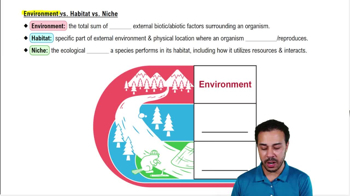
The type of environment in which an organism or group normally lives or occurs.
Temperature, salinity, pH, elevation, sunlight, moisture, and nutrients.
Distribution of competitors, predators, and other species interactions.
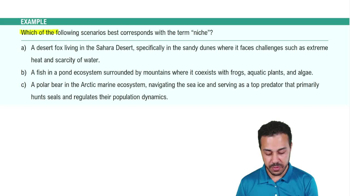
The physical and biological conditions a species needs to grow, survive, and reproduce; a multi-dimensional space of environmental factors affecting a species.
Habitat is where an organism lives; niche is how it lives and interacts within that environment.
Species with a wide niche that can survive and reproduce under many conditions (e.g., rats).
Species with a narrow niche requiring specific conditions (e.g., koalas eating only eucalyptus leaves).
The full range of environmental conditions under which a species can survive and reproduce without biotic interactions.
The portion of the fundamental niche actually occupied by a species, limited by competition, predation, and other biotic factors.
Because biotic interactions like competition and predation restrict where a species can persist.
Movement of organisms or propagules from their birthplace to new locations.
Mountain ranges, water bodies, and unsuitable habitats that limit organism movement.
Habitat fragmentation from roads, buildings, and development that prevent organism movement.
To find new mates, increase genetic variation, find new food, avoid crowding, disease, predation, and expand range size.
Species traits, resource availability, habitat distribution, and individual behavior.
Apple trees have limited dispersal because seeds fall near the parent; animals may aid seed dispersal.
Territorial sticklebacks repel others, limiting dispersal; good conditions and dispersal facilitators like birds can enhance dispersal.
Transplant organisms outside their range; survival indicates dispersal limits range, death suggests other limiting factors.
Dispersal is often one-way movement to new locations; migration is seasonal, round-trip movement.
Monarchs have a northern range limited by milkweed distribution and migrate seasonally thousands of miles, returning after migration.
Saguaro cacti are limited to areas where freezing temperatures do not persist beyond 36 hours, restricting their northern range.
Chthamalus barnacles are limited lower in the tidal zone by competition with Balanus barnacles.
Abiotic factors like desiccation tolerance and biotic factors like competition together determine barnacle zonation.
Speciation, continental drift, and origin location can limit where species are found despite suitable habitats elsewhere.