Skip to main content
General Biology
My Course
Learn
Exam Prep
AI Tutor
Study Guides
Textbook Solutions
Flashcards
Explore
Try the app
My Course
Learn
Exam Prep
AI Tutor
Study Guides
Textbook Solutions
Flashcards
Explore
Try the app
Back
Population Ecology and Growth Models
You can tap to flip the card.
What defines a population in biology?
You can tap to flip the card.
👆
What defines a population in biology?
A population is a group of individuals of a single species living in the same general area.
Track progress
Control buttons has been changed to "navigation" mode.
1/20
Recommended videos
01:48
Factors Affecting Population Size (N)
2540
views
12
rank
01:52
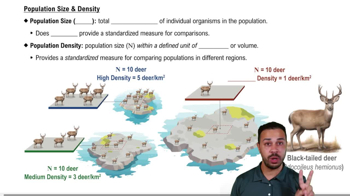
Population Size & Density
2839
views
16
rank
01:51
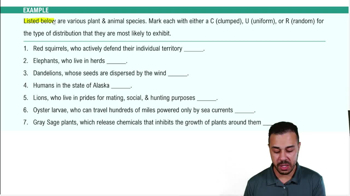
Introduction to Population Ecology Example 3
2380
views
7
rank
Terms in this set (20)
Hide definitions
What defines a population in biology?
A population is a group of individuals of a single species living in the same general area.
What is population density?
Population density is the number of individuals per unit area or volume.
What is dispersion in population ecology?
Dispersion is the pattern of spacing among individuals within a population.
Name three common patterns of dispersion.
Clumped, uniform, and random dispersion.
What influences clumped dispersion?
Resource availability and social behavior often cause individuals to aggregate in patches.
What causes uniform dispersion?
Social interactions like territoriality, where individuals defend bounded spaces, lead to even spacing.
What characterizes random dispersion?
Individuals are spaced unpredictably, with no strong attractions or repulsions.
What is a life table in population ecology?
An age-specific summary of the survival pattern of a population, often following a cohort.
What are the three types of survivorship curves?
Type I: low early death rates; Type II: constant death rate; Type III: high early death rates.
What is a reproductive table or fertility schedule?
An age-specific summary of the reproductive rates in a population, often focusing on females.
How is population growth rate (r) calculated ignoring immigration and emigration?
r = birth rate (b) minus death rate (m).
What is zero population growth (ZPG)?
When the birth rate equals the death rate, resulting in r = 0 and no population size change.
Write the exponential growth equation for population size N.
dN/dt = rmax N, where rmax is the maximum per capita growth rate.
What shape does the exponential growth curve have?
A J-shaped curve representing rapid population increase under ideal conditions.
What is carrying capacity (K)?
The maximum population size that the environment can sustainably support.
How does the logistic growth model modify exponential growth?
It adds a term to reduce growth rate as population size (N) approaches carrying capacity (K).
Write the logistic growth equation.
dN/dt = rmax N (K - N) / K.
What happens to the per capita growth rate as N approaches K in logistic growth?
The per capita growth rate declines, slowing population growth.
What is the Allee effect?
A phenomenon where individuals have difficulty surviving or reproducing at low population sizes.
Name four factors that determine population size and density.
Births, deaths, immigration, and emigration.
 BackBack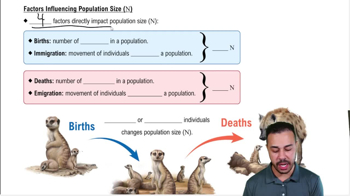
 01:48
01:48