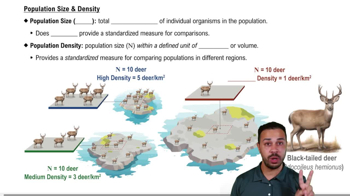
A population is a group of individuals of the same species that live together and interact, including reproduction and competition.
Define population distribution.
Population distribution is the geographic area where individuals of a species are present.
What is population abundance?
Population abundance is the number of individuals of a species found in a given area, measured as population size or density.
Difference between genet and ramet.
A genet is an individual from a single fertilization event (genetic individual), while a ramet is a physiologically independent organism that may be part of a genet, such as asexually produced clones.
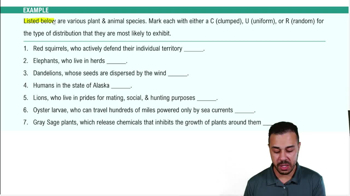
What are the three small-scale population distribution patterns?
Populations can be distributed randomly, regularly (equally spaced), or clumped (grouped in patches).
How does body size relate to population density?
Larger organisms tend to have lower population densities, showing a negative correlation between body size and density.
What is population density?
Population density is the number of individuals per unit area.
How is population size estimated?
Population size is estimated by multiplying population density by the total area occupied.
What challenges arise when counting individuals in a population?
Challenges include choosing a representative sample, sampling bias, and ensuring accuracy and precision in estimates.
Difference between open and closed populations.
An open population exchanges individuals with other populations, while a closed population is isolated with no exchange.
What is a metapopulation?
A metapopulation is an assemblage of spatially separated populations of the same species that interact through migration.
What is the balance required for metapopulation persistence?
The rate of local population extinction (e) must be less than or equal to the rate of colonization (c), expressed as \(\frac{e}{c} \leq 1\).
Define source and sink populations in metapopulations.
Source populations produce more offspring than can survive, dispersing excess individuals; sink populations produce fewer offspring than needed to sustain themselves and rely on immigrants from sources.
What is demographic data in population ecology?
Demographic data includes age classes, birth rates, death rates, and other life history traits of a population.
How do quadrats help estimate population density?
Quadrats are defined plots used to count individuals of sessile organisms, allowing extrapolation of density to larger areas.
Why are mark-recapture studies used?
Mark-recapture is used to estimate population size of mobile organisms by capturing, marking, releasing, and recapturing individuals.
What is the significance of spatial scale in ecology?
Ecology studies processes at multiple scales, from individuals to populations, with population ecology focusing on groups of interacting individuals.
What is the difference between precision and accuracy in population estimates?
Accuracy is how close estimates are to the true value; precision is how consistent estimates are with each other.
What factors influence population distribution patterns?
Distribution patterns are influenced by resource availability, social behavior, and environmental conditions.
Why is repeated sampling important in population studies?
Populations change over space and time, so repeated sampling captures temporal and spatial variation for accurate estimates.
 Back
Back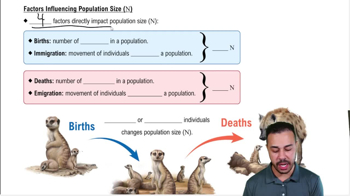
 01:48
01:48