 Back
BackProperties of Life in General Biology 1.2
 09:26
09:26
Terms in this set (20)
Biology is the scientific study of life.
Life is recognized mainly by what living things do, such as growth, reproduction, and energy processing.
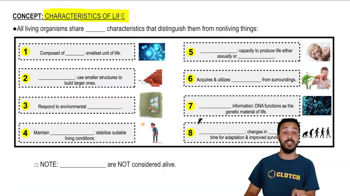
Order, cells, growth and development, energy processing, regulation, response to the environment, reproduction, and evolution.
Viruses have an ordered structure but cannot process energy or are composed of cells, so they lack all properties of life.
Order refers to the organized structure, such as the arrangement of cells or body parts.
Cells are the basic structural and functional units of life in all living organisms.
Growth and development refer to the process by which an organism matures and changes over time.
Energy processing is the ability to take in energy and use it for metabolic activities.
Regulation is the ability of an organism to maintain internal stability, such as temperature or salt balance.
Living organisms detect and respond to environmental stimuli to survive and adapt.
Reproduction is the process by which organisms produce new individuals, ensuring species continuation.
Evolution is the process by which populations change over generations through genetic variation and natural selection.
Sea turtles regulate salt by excreting excess salt through their eyes.
Sea turtles grow from hatchlings into mature adults over several decades.
Warmer temperatures favor female development, while cooler temperatures favor male development.
Curiosity searches for chemical evidence of past or present life on Mars by detecting energy-processing substances.
Enceladus has abundant water and geothermal activity, which may support life.
Yes, but they do not display all properties simultaneously, which is required to be considered alive.
Living things display all key properties of life simultaneously, unlike nonliving things.
Large organisms are made of trillions of cells that perform specialized functions.