Skip to main content
General Biology
My Course
Learn
Exam Prep
AI Tutor
Study Guides
Textbook Solutions
Flashcards
Explore
Try the app
My Course
Learn
Exam Prep
AI Tutor
Study Guides
Textbook Solutions
Flashcards
Explore
Try the app
Back
Protists - General Biology Lab Practical 1
You can tap to flip the card.
What defines a protist?
You can tap to flip the card.
👆
What defines a protist?
Protists
are eukaryotes with a nucleus and membrane-bound organelles, mostly unicellular with complex cell organization.
Track progress
Control buttons has been changed to "navigation" mode.
1/28
Recommended videos
03:23
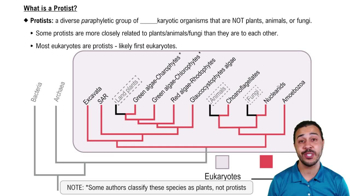
What is a Protist?
4093
views
78
rank
02:30
Introduction to Protists Example 1
2980
views
45
rank
01:39
Introduction to Protists Example 2
2844
views
22
rank
Terms in this set (28)
Hide definitions
What defines a protist?
Protists
are eukaryotes with a nucleus and membrane-bound organelles, mostly unicellular with complex cell organization.
What are the three nutritional modes of protists?
Photoautotrophs
contain chloroplasts,
heterotrophs
absorb or ingest organic molecules, and
mixotrophs
combine photosynthesis and heterotrophic nutrition.
What distinguishes Euglenozoans?
Presence of a
spiral or crystalline rod
inside their flagella.
Characteristics and ecological role of Trypanosoma
A flagellated parasite with an undulating membrane; alternates between vertebrate and invertebrate hosts.
Characteristics and ecological role of Euglena
Green, elongate flagellate with a pigmented eye spot; common mixotroph in freshwater ponds.
What defines Stramenopiles?
Flagella with many hairlike lateral projections; includes diatoms, brown algae, and water molds.
Characteristics and ecological role of Diatoms
Unicellular algae with silica glass-like walls; abundant in oceans and lakes, important primary producers.
Economic importance of diatoms
Accumulations produce
diatomaceous earth
used in filtration and abrasives.
Characteristics and ecological role of Brown Algae
Largest, most complex algae with brown pigment fucoxanthin; mostly marine, including giant kelps.
Economic importance of Brown Algae
Many species harvested for commercial food products.
Characteristics and ecological role of Water molds (Saprolegnia)
Multinucleate filaments acting as decomposers or parasites; cell walls contain cellulose, not chitin.
What defines Alveolates?
Have membrane-bound sac-like alveoli under the cell membrane; includes ciliates, dinoflagellates, and apicomplexans.
Characteristics and ecological role of Ciliates
Heterotrophic protists using cilia to move and feed; common in freshwater ponds.
Characteristics and ecological role of Dinoflagellates
Cells reinforced by cellulose plates with two spinning flagella; foundation of aquatic food chains, can cause red tides.
Characteristics of Apicomplexans
Parasites with an apex organelle for host penetration; complex life cycles requiring multiple hosts.
What is Plasmodium?
An apicomplexan parasite causing malaria; requires mosquitoes and humans to complete its life cycle.
What defines Rhizarians?
Amoeboid, heterotrophic protists with threadlike pseudopodia; includes Foraminiferans and Radiolarians.
Characteristics and ecological role of Foraminiferans
Have hard, porous calcium carbonate shells called tests; marine plankton that form fossils and limestone.
Characteristics and ecological role of Radiolarians
Have silica skeletons with axopodia; skeletons contribute to sea floor ooze.
What defines Amoebozoans?
Protists with lobe-shaped pseudopodia; includes amoebas and slime molds.
Characteristics and ecological role of Amoeba
Move and feed using pseudopodia; common freshwater heterotrophs.
Characteristics and ecological role of Physarum
Phagocytic heterotroph with multinucleate plasmodium stage; decomposer on decaying forest material.
Characteristics and ecological role of Dictyostelium
Exist as individual amoeboid cells but aggregate to form fruiting bodies when food is scarce; forest decomposer.
What defines Rhodophyta (Red Algae)?
Contain pigment phycoerythrin; includes unicellular and multicellular algae abundant in warm tropical oceans.
Characteristics and economic importance of Porphyra
Multicellular red algae with broad leaf-like structures; used as seaweed wrappers for sushi.
What defines Chlorophyta (Green Algae)?
Chloroplasts similar to land plants; includes unicellular and multicellular algae.
Characteristics and economic importance of Ulva
Multicellular green algae with broad leaf-like structures; primary producer and nutrition supplement.
Characteristics and ecological role of Spirogyra
Filamentous green algae; autotrophic primary producer.
 BackBack
 03:23