Skip to main content
General Biology
My Course
Learn
Exam Prep
AI Tutor
Study Guides
Textbook Solutions
Flashcards
Explore
Try the app
My Course
Learn
Exam Prep
AI Tutor
Study Guides
Textbook Solutions
Flashcards
Explore
Try the app
Back
Scientific Method and Yeast Fermentation in General Biology lab 2
You can tap to flip the card.
What is the first step of the Scientific Method?
You can tap to flip the card.
👆
What is the first step of the Scientific Method?
Observation of an occurrence which leads to stating a problem or question to answer.
Track progress
Control buttons has been changed to "navigation" mode.
1/21
Recommended videos
01:35
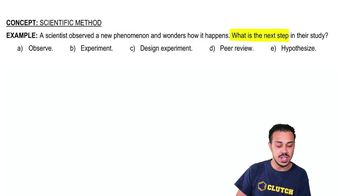
Scientific Method Example 1
13383
views
300
rank
03:03
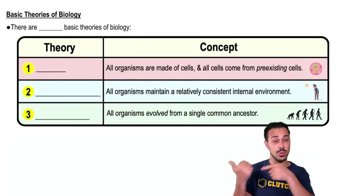
Basic Theories of Biology
14198
views
290
rank
1
comments
06:29
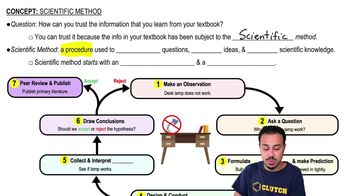
Scientific Method
22420
views
532
rank
1
comments
Terms in this set (21)
Hide definitions
What is the first step of the Scientific Method?
Observation of an occurrence which leads to stating a problem or question to answer.
Define a hypothesis in the Scientific Method.
A tentative, testable explanation based on current knowledge, formulated using inductive reasoning.
What is inductive reasoning?
Reasoning from specific details to a general statement or conclusion.
What is deductive reasoning in the context of the Scientific Method?
Starting with a general statement and inferring specific conclusions to design experiments.
What is the difference between independent and dependent variables?
The independent variable is manipulated; the dependent variable is the expected result measured.
What is the purpose of controls in an experiment?
To ensure validity by comparing samples that undergo all steps except the one being tested.
What distinguishes positive controls from negative controls?
Positive controls contain a known sample that produces a reaction; negative controls do not change the reagent.
Can a hypothesis be proven true in science?
No, it can only be supported or refuted by data; repeated support may lead to a scientific theory.
What is catabolism in yeast metabolism?
A metabolic reaction breaking down macromolecules to release stored energy.
What are the two metabolic pathways yeast can use to break down sugars?
Aerobic metabolism (with oxygen) and fermentation (anaerobic metabolism without oxygen).
Write the general equation for aerobic metabolism of sugar by yeast.
Sugar + O2 → H2O + CO2 + released energy.
Write the general equation for fermentation by yeast.
Sugar → Ethanol + CO2 + released energy.
Why does aerobic metabolism not change gas pressure in a sealed chamber?
Because oxygen consumption equals carbon dioxide production, keeping gas pressure constant.
Why does fermentation increase gas pressure in a sealed chamber?
Because CO2 is produced without oxygen consumption, increasing gas pressure.
Why is oil added on top of the yeast-sugar mixture in the experiment?
To create an airtight seal preventing oxygen from entering, ensuring fermentation occurs.
What gas does the Vernier Gas Pressure Sensor measure in this experiment?
Carbon dioxide (CO2) produced during fermentation.
What is the independent variable in the yeast fermentation experiment?
The type of sugar solution used (e.g., glucose, sucrose, lactose).
What is the dependent variable in the yeast fermentation experiment?
The fermentation rate measured as the slope of gas pressure increase (kPa/sec).
Why is yeast incubated for 10 minutes before data collection?
To allow yeast to begin fermentation and stabilize gas production for accurate measurement.
Why is water used as one experimental treatment in the yeast fermentation experiment?
As a negative control to show no fermentation occurs without sugar.
List five conditions kept constant across all experimental treatments.
Temperature, yeast concentration, incubation time, volume of solutions, and airtight sealing.
 BackBack
 01:35