Skip to main content
General Biology
My Course
Learn
Exam Prep
AI Tutor
Study Guides
Textbook Solutions
Flashcards
Explore
Try the app
My Course
Learn
Exam Prep
AI Tutor
Study Guides
Textbook Solutions
Flashcards
Explore
Try the app
Back
The Cell Cycle and Mitosis
You can tap to flip the card.
What does the cell theory state about cells?
You can tap to flip the card.
👆
What does the cell theory state about cells?
All cells come from pre-existing cells.
Track progress
Control buttons has been changed to "navigation" mode.
1/20
Recommended videos
Guided course
04:45
Asexual vs. Sexual Reproduction
16380
views
351
rank
3
comments
Guided course
09:40
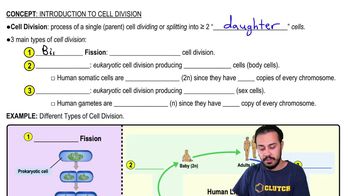
Introduction to Cell Division
25102
views
566
rank
1
comments
Guided course
03:19
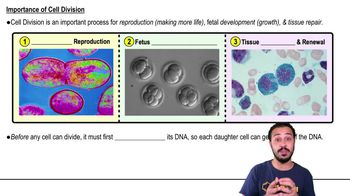
Importance of Cell Division
15573
views
492
rank
Terms in this set (20)
Hide definitions
What does the cell theory state about cells?
All cells come from pre-existing cells.
What is the cell cycle?
The
cell cycle
refers to events where a cell's life begins and ends with one cell dividing to produce two new cells.
What are the main phases of the cell cycle?
Interphase
(cell growth and DNA replication) and
Cell Division
(mitosis and cytokinesis).
What happens during interphase?
The cell spends most of its life in interphase, growing and replicating DNA in preparation for division.
What are the three subphases of interphase?
G1
(growth),
S
(DNA synthesis), and
G2
(growth and preparation for mitosis).
What is mitosis?
Mitosis is the division of the nucleus, resulting in two identical daughter nuclei.
What is cytokinesis?
Cytokinesis is the division of the cytoplasm, completing cell division.
What are chromosomes made of?
Chromosomes are made of
DNA and proteins
.
What is a chromosome?
A chromosome is a structure of DNA that carries genetic information.
What are sister chromatids?
Sister chromatids are two identical copies of a chromosome connected at the centromere.
How many chromosomes do humans have?
Humans have
46 chromosomes
arranged in 23 pairs.
What happens during prophase?
Duplicated chromosomes condense and become visible; the nuclear envelope disappears; centrioles move apart forming spindle fibers.
What occurs in prometaphase?
The spindle continues forming; the nuclear envelope fragments; kinetochores attach to spindle fibers.
What happens during metaphase?
Chromosomes align at the cell's equator; centromeres are at the metaphase plate.
Describe anaphase in mitosis.
Sister chromatids split and are pulled to opposite poles; the cell elongates.
What occurs during telophase?
Nuclear envelopes form around chromosomes; chromosomes decondense; spindle microtubules break down; cytokinesis begins.
What is cytokinesis in animal cells?
The cytoplasm divides by a cleavage furrow that pinches the cell into two.
How does cytokinesis differ in plant cells?
Vesicles from the Golgi apparatus form a cell plate that develops into a new cell wall.
What is binary fission?
Binary fission is the process of cell division in prokaryotes, producing two identical cells.
Why is mitosis important?
Mitosis ensures genetic material is equally divided, allowing growth, repair, and asexual reproduction.
 BackBack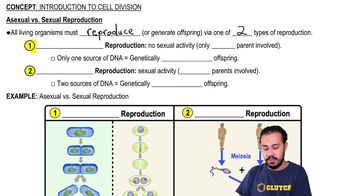
 04:45
04:45