 Back
BackL 4.1: Algal Protists: Diversity, Structure, and Ecological Roles
Study Guide - Smart Notes
 Tailored notes based on your materials, expanded with key definitions, examples, and context.
L 4.1
Introduction to Algal Protists
Algal protists are a diverse group of primarily aquatic, photosynthetic eukaryotes that play fundamental roles in global ecosystems. They are classified within the Kingdom Protista and are found in a variety of moist environments, ranging from freshwater to marine habitats. Algal protists are essential for oxygen production, serve as the base of many aquatic food webs, and exhibit a wide range of cellular organizations and morphologies.
Classification and Phylogeny of Protists
Paraphyletic and Polyphyletic Groups
Protists are not a monophyletic group; instead, they are classified as paraphyletic or polyphyletic, meaning they do not include all descendants of a common ancestor. This classification reflects the evolutionary complexity and diversity within the group.
Paraphyletic group: Includes some but not all descendants of a common ancestor.
Polyphyletic group: Composed of unrelated organisms descended from more than one ancestor.
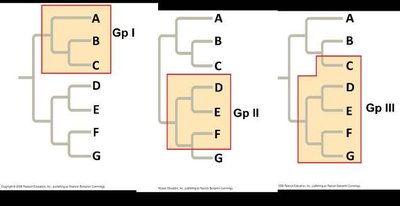
Additional info: Understanding these groupings is crucial for interpreting evolutionary relationships among protists and other eukaryotes.
Major Groups of Algal Protists
Green Algae (Chlorophyta)
Green algae are primarily aquatic, photosynthetic eukaryotes containing chlorophylls a and b. They range from unicellular to multicellular forms and store starch in their plastids. Green algae are closely related to land plants and are important for studying plant evolution.
Cellular organization: Unicellular, colonial, and multicellular forms.
Examples: Chlamydomonas (unicellular), Volvox (colonial), Ulva (multicellular).
Red Algae (Rhodophyta)
Red algae are mostly multicellular marine organisms characterized by the presence of phycobilin pigments, which give them their distinctive red color. They lack flagella and centrioles and are important contributors to coral reef formation through the secretion of calcium carbonate.
Pigments: Chlorophyll a, phycobilins (phycoerythrin and phycocyanin).
Storage product: Floridean starch.
Applications: Agar and carrageenan production.
Brown Algae (Phaeophyta)
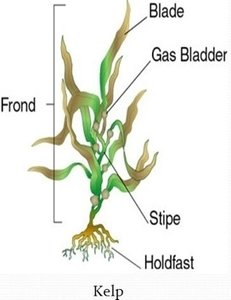
Brown algae are large, multicellular marine organisms, including kelps, that possess chlorophylls a and c and the brown pigment fucoxanthin. They form complex structures and are ecologically significant in coastal environments.
Structure: Differentiated into blade, stipe, holdfast, and gas bladders.
Example: Macrocystis (kelp), Sargassum.
Diatoms (Bacillariophyta)
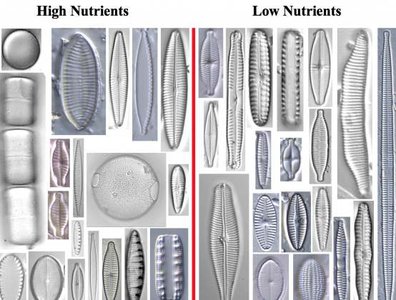
Diatoms are unicellular or colonial algae encased in silica cell walls called frustules. They are highly diverse and serve as important indicators of water quality due to their sensitivity to environmental changes.
Pigments: Chlorophylls a and c, fucoxanthin.
Storage: Oil droplets or soluble carbohydrates.
Ecological role: Major primary producers in aquatic ecosystems.
Dinoflagellates (Dinophyta)
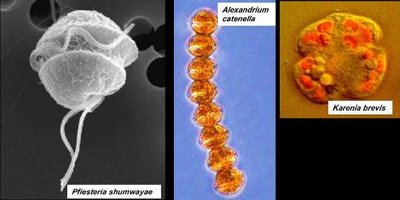
Dinoflagellates are mostly unicellular, flagellated algae found in marine and freshwater environments. Some species are photosynthetic, while others are predatory or parasitic. They are known for causing harmful algal blooms, such as red tides.
Motility: Two flagella (one trailing, one wrapped around the cell).
Cell wall: Cellulose plates.
Notable genera: Alexandrium, Karenia, Pfiesteria.
Cellular Organization in Algae
Types of Organization
Unicellular: Single unattached cells, may be motile or non-motile.
Filamentous: Chains of cells attached end to end, can be branched or unbranched.
Colonial: Groups of cells attached in a non-filamentous manner.
Multicellular: Complex forms with differentiated cells (e.g., kelps).
Key Structural and Functional Features
Chloroplast Structure and Endosymbiosis
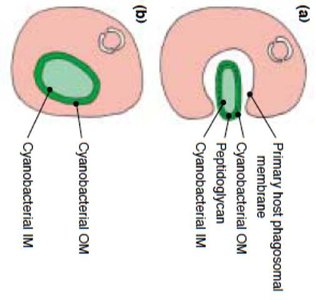
Algal chloroplasts are surrounded by multiple membranes, reflecting their evolutionary origin via primary and secondary endosymbiosis. The number and arrangement of membranes provide clues to their evolutionary history.
Flagella and Motility
Many algal protists possess flagella for movement. In stramenopiles, two unequal flagella are typical: an anterior tinsel-type with lateral bristles and a posterior whiplash-type.
Cell Wall Composition
Green algae: Cellulose
Red algae: Carrageenan
Brown algae: Cellulose and algin
Diatoms: Silica
Dinoflagellates: Cellulose (some lack cell walls)
Ecological and Economic Importance
Oxygen Production and Food Webs
Algal protists are responsible for a significant portion of global oxygen production and form the base of aquatic food chains. Their diversity and abundance make them critical to ecosystem functioning.
Indicators of Environmental Health
Diatoms, in particular, are used as bioindicators to assess water quality and historical environmental conditions due to their sensitivity to nutrient levels and their preservation in sediments.
Major Algal Group Features Table
The following table summarizes the main features of major algal groups, including form, motility, cell wall composition, pigments, and storage substances.
Phylum (Group) | Form | Motility | Cell Wall Component | Pigments | Storage Substances |
|---|---|---|---|---|---|
Chlorophyta (Green algae) | Unicellular to multicellular | Motile and nonmotile; some glide | Cellulose | Chlorophyll a and b; carotenoids | Starch |
Rhodophyta (Red algae) | Some unicellular, but most multicellular | Nonmotile | Carrageenan | Chlorophyll a and d; carotenoids; phycobilins | Floridean starch |
Phaeophyta (Brown algae) | Multicellular | Nonmotile; flagellated gametes | Cellulose, algin | Chlorophyll a and c; carotenoids; fucoxanthin | Laminarin |
Bacillariophyta (Diatoms) | Unicellular; some colonial | Most nonmotile; some glide | Silica | Chlorophyll a and c; carotenoids; fucoxanthin | Oil droplets or soluble carbohydrates |
Dinophyta (Dinoflagellates) | Unicellular; some colonial | 2 flagella, 1 trailing, 1 wrapped around cell | Cellulose; some have no cell wall | Chlorophyll a and c; carotenoids; fucoxanthin | Starch |
Euglenophyta (Euglenoids) | Unicellular | 2 flagella, 1 long, 1 short | No cell wall; pellicle protein layer | Chlorophyll a and b; carotenoids | Paramylon |
Getting Closer to Land Plants
Phragmoplast
The phragmoplast is a structure that forms during late cytokinesis in certain algae and land plants, serving as a scaffold for cell plate assembly and the new cell wall. It is a key evolutionary feature linking some algal groups to terrestrial plants.
Plasmodesmata
Plasmodesmata are microscopic channels traversing cell walls, allowing transport and communication between cells. They are present in some algae (Charophyceae, Coleochaetales) and all land plants, highlighting evolutionary continuity.
Pyrenoid
The pyrenoid is a chloroplast compartment that enhances the efficiency of RuBisCO, the enzyme responsible for carbon fixation in photosynthesis. Pyrenoids are present in most algae and are being studied for their potential to improve crop yields.
Examples of Algal Diversity
Desmids (Order Desmidiales)
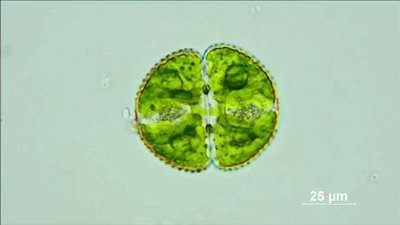
Desmids are unicellular green algae with highly symmetrical semi-cells, serving as model organisms for studying morphological development. They secrete mucilage and reproduce by fission.
Acetabularia (Chlorophyta)
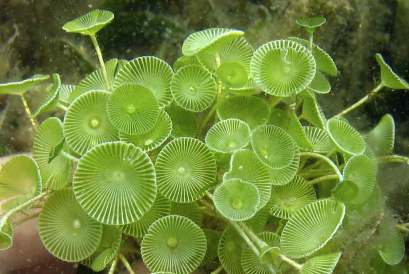
Acetabularia is a single-celled green alga notable for its large size and complex morphology, making it a model organism for cell biology research.
Life Cycle and Structure of Acetabularia
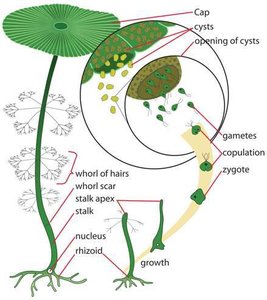
The life cycle of Acetabularia involves the formation of gametes, zygote development, and cyst formation, illustrating the complexity possible in single-celled algae.
Summary
Algal protists are a diverse and ecologically significant group of eukaryotes, exhibiting a wide range of morphologies, life cycles, and ecological roles. Their study provides insights into the evolution of photosynthesis, multicellularity, and the transition to land plants.
