 Back
BackPhotosynthesis: Mechanisms, Structures, and Adaptations
Study Guide - Smart Notes
 Tailored notes based on your materials, expanded with key definitions, examples, and context.
Photosynthesis: Introduction and Overview
Definition and Importance
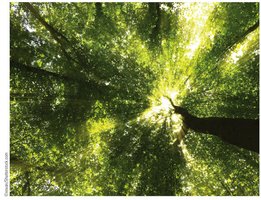
Photosynthesis is the process by which plants, algae, and some bacteria convert light energy into chemical energy, producing organic molecules and oxygen from carbon dioxide and water. This process is fundamental to life on Earth, as it is the primary source of energy for most living organisms and is responsible for the oxygen in our atmosphere.
Light energy is captured and stored in the bonds of organic molecules (e.g., glucose).
Photosynthesis removes CO2 from the atmosphere and releases O2 as a byproduct.
The Electromagnetic Spectrum and Visible Light
Properties of Visible Light
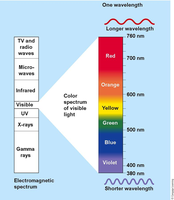
Visible light is a small segment of the electromagnetic (EM) spectrum, which includes all forms of electromagnetic radiation. Photosynthetic organisms use visible light, which ranges from 380 to 760 nanometers (nm) in wavelength.
Violet light has the shortest wavelength and highest energy.
Red light has the longest wavelength and lowest energy within the visible spectrum.
Different wavelengths correspond to different colors, which are absorbed or reflected by pigments in plants.
Chloroplasts: The Site of Photosynthesis
Structure and Function
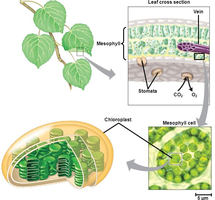
Chloroplasts are specialized organelles found in the mesophyll cells of plant leaves. They contain the pigment chlorophyll and are the site where photosynthesis occurs.
Each mesophyll cell contains 20–100 chloroplasts.
Stomata are microscopic pores on the leaf surface that allow for gas exchange (CO2 in, O2 out).
Internal Structure of Chloroplasts
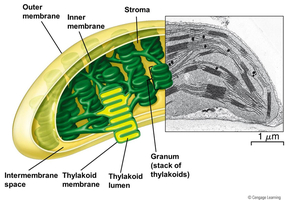
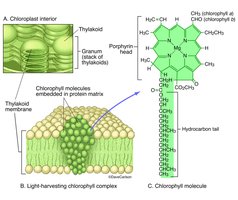
Chloroplasts are enclosed by a double membrane and contain an internal system of membranes called thylakoids, which are stacked into grana. The fluid-filled space surrounding the thylakoids is the stroma.
Thylakoid membranes house the pigments and proteins involved in the light-dependent reactions.
The stroma contains enzymes for the Calvin cycle (light-independent reactions).
Pigments in Photosynthesis
Types and Functions of Pigments
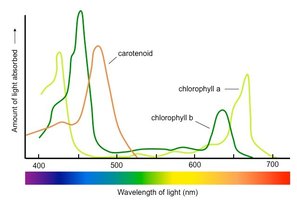
Photosynthetic pigments absorb light energy at specific wavelengths. The main pigment is chlorophyll a, with accessory pigments such as chlorophyll b and carotenoids expanding the range of light absorption.
Chlorophyll a: Initiates the light-dependent reactions.
Chlorophyll b: Accessory pigment, broadens the spectrum of absorbed light.
Carotenoids: Absorb wavelengths not efficiently absorbed by chlorophylls; protect against photo-damage.
Absorption Spectra of Photosynthetic Pigments
Different pigments absorb light at different wavelengths, which is illustrated by their absorption spectra. Chlorophylls absorb mainly blue and red light, reflecting green, which is why leaves appear green.
Carotenoids absorb in the blue-green region and reflect yellow-orange light.
Experimental Evidence: Engelmann’s Experiment
Demonstrating the Action Spectrum of Photosynthesis
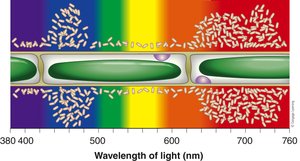
T. W. Engelmann’s experiment used algae and aerobic bacteria to show that photosynthesis is most efficient at blue and red wavelengths, corresponding to the absorption peaks of chlorophyll.
Bacteria congregated where oxygen production (and thus photosynthesis) was highest.
Overview of Photosynthesis: Two Main Stages
Light-Dependent Reactions
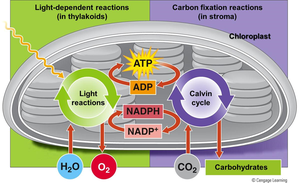
These reactions occur in the thylakoid membranes and convert light energy into chemical energy in the form of ATP and NADPH. Water is split, releasing oxygen as a byproduct.
Light energy excites electrons in chlorophyll, which are transferred to NADP+ to form NADPH.
ATP is generated by chemiosmosis as protons flow through ATP synthase.
Oxygen is released from the splitting of water molecules.
Light-Independent Reactions (Calvin Cycle and Alternatives)
These reactions occur in the stroma and use ATP and NADPH to fix carbon dioxide into carbohydrates. The Calvin cycle is the most common pathway, but C4 and CAM pathways are adaptations to specific environments.
Calvin Cycle (C3 pathway): Produces a 3-carbon compound (G3P) as the first stable product.
C4 pathway: Adaptation in some plants to minimize photorespiration and maximize efficiency in hot, dry environments.
CAM pathway: Adaptation in succulents and other arid-adapted plants to fix carbon at night, reducing water loss.
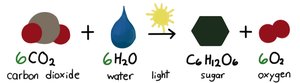
Summary Equation of Photosynthesis
The overall chemical equation for photosynthesis is:
Adaptations: C3, C4, and CAM Pathways
Gas Exchange and Water Loss
Plants must balance the need for CO2 uptake with minimizing water loss. On hot, dry days, stomata close to conserve water, which can limit photosynthesis and lead to photorespiration in C3 plants.
C4 Pathway
C4 plants first fix CO2 into a 4-carbon compound in mesophyll cells, which is then transported to bundle sheath cells for entry into the Calvin cycle. This adaptation reduces photorespiration and increases efficiency in high light and temperature environments.
CAM Pathway
CAM plants open their stomata at night to fix CO2 into organic acids, which are then used during the day for photosynthesis while stomata are closed, minimizing water loss.
Review Questions
What part of the light spectrum does visible light fall under?
What are photons and how are they important in photosynthesis?
Which organelle carries out photosynthesis? Where are they found in plants and why?
What is the pigment molecule found in leaves? What’s their role?
Why do leaves appear green?
What did Engelmann’s experiment prove?
Describe the events in the light dependent and independent pathways.
What happens during Calvin (C3) Cycle?
What are C4 and CAM pathways?
Why do some plants adopt the C4 and CAM pathways?
