 Back
BackAbsolute Extrema and Applications of Extrema (Business Calculus Study Notes)
Study Guide - Smart Notes
 Tailored notes based on your materials, expanded with key definitions, examples, and context.
Section 6.1: Absolute Extrema
Definition of Absolute Extrema
In calculus, absolute extrema refer to the highest and lowest values that a function attains on a given domain. These are called the absolute maximum and absolute minimum respectively.
Absolute Minimum: A function f has an absolute minimum at c if f(c) \leq f(x) for all x in the domain I.
Absolute Maximum: A function f has an absolute maximum at c if f(c) \geq f(x) for all x in the domain I.
Example: The graphs below illustrate how to determine absolute extrema for functions on different domains. The left graph is defined on a closed interval [0,4], while the right graph is defined on the entire real line (−∞, ∞).
![Graph of a function on [0,4] showing endpoints and a minimum](https://static.studychannel.pearsonprd.tech/study_guide_files/business-calculus/sub_images/4afa4357_image_1.png)
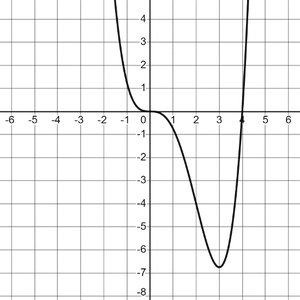
Additional info: The left graph shows both an absolute minimum and maximum within the closed interval, while the right graph demonstrates that an absolute maximum may not exist on an open or infinite domain.
The Extreme-Value Theorem
The Extreme-Value Theorem states that if a function f is continuous on a closed interval [a, b], then f must attain both an absolute maximum and an absolute minimum on that interval.
This theorem does not apply to open intervals or unbounded domains.
Absolute extrema can only occur at the endpoints or at critical values (where the derivative is zero or undefined).
Finding Absolute Extrema
To find the absolute maximum and minimum values of a continuous function f on a closed interval [a, b], follow these steps:
Find the derivative f'(x).
Determine all critical values in [a, b] (where f'(x) = 0 or f'(x) does not exist).
List all critical values and the endpoints a and b.
Evaluate f(x) at each value from step 3.
The largest value is the absolute maximum; the smallest is the absolute minimum.
Example: Find the absolute maximum and minimum of f(x) = x^2 - 12x on [−1, 5].
Example: Find the absolute maximum and minimum of f(x) = x^3 - 4 on [−1, 2].
Additional info: For each example, compute f'(x), solve for critical points, and compare function values at these points and endpoints.
Critical Point Theorem
If a function f has exactly one critical value c in an interval I and f''(c) exists:
If f''(c) < 0, then f(c) is an absolute maximum.
If f''(c) > 0, then f(c) is an absolute minimum.
Example: Find the absolute extrema of f(x) = -x^3 + 6x - 3 on (−∞, ∞).
Section 6.2: Applications of Extrema
Maximum Sustainable Harvest
In population dynamics, the maximum sustainable harvest is the largest number of individuals that can be regularly removed from a population without causing long-term decline. This is modeled using a spawner-recruit function R = f(S), where S is the number of adults present during the reproductive period, and R is the number returning in the next cycle.
If R > S, the harvest is H = R - S = f(S) - S.
The maximum sustainable harvest is H(S^*), where S^* maximizes H(S).
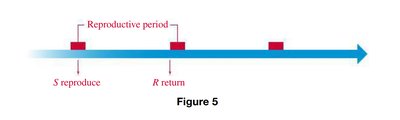
Example: If f(S) = \frac{600S}{S+3}, find the maximum sustainable harvest (S in thousands).
Example: If f(S) = 45S^{2/3}, find the maximum sustainable harvest (S in thousands).
Additional info: To solve, set up H(S) = f(S) - S, find the derivative, set it to zero, and solve for S^*.
Other Applications of Extrema
Optimization in Geometry: A farmer wants to construct a rectangular pen with one additional fence across its width, using 2400 m of fencing. Find the maximum area that can be enclosed.
Environmental Application: The percentage of selenium in soil after flushing is given by f(x) = \frac{x^2 + 36}{2x}, for 1 \leq x \leq 12 (x in months). Find when selenium is minimized and the minimum percentage.
Additional info: For each application, express the quantity to be optimized as a function, find its critical points, and evaluate at endpoints if the domain is closed.
Summary Table: Steps for Finding Absolute Extrema
Step | Description |
|---|---|
1 | Find the derivative f'(x) |
2 | Find all critical values in the interval |
3 | List critical values and endpoints |
4 | Evaluate f(x) at each value |
5 | Identify the largest (maximum) and smallest (minimum) values |
