 Back
BackBusiness Calculus Exam 1 Study Guide: Derivatives, Rates of Change, and Curve Analysis
Study Guide - Smart Notes
 Tailored notes based on your materials, expanded with key definitions, examples, and context.
Slope and Linear Functions
Slope of a Straight Line
The slope of a straight line measures its steepness and direction. It is a fundamental concept in calculus and business applications, such as cost and revenue analysis.
Slope Formula:
Parallel Lines: Two lines are parallel if their slopes are equal ().
Perpendicular Lines: Two lines are perpendicular if the product of their slopes is ().
Equation of a Line: or
Example: Find the equation of the line parallel to with an x-intercept of 5.
Rewrite:
Parallel slope:
Point:
Equation:
Example (Business Application): Estimating sales using a linear function for gallons sold at price .
Points: and
Slope:
Equation:
Estimate: gallons
Derivatives and Tangent Lines
Derivative Notation and Basic Rules
The derivative measures the rate of change of a function. It is denoted by , , , or .
Constant Function:
Linear Function:
Power Rule:
Equation of Tangent Line:
Example: Find the derivative of .
Rewrite:
Derivative:
Example: , , ,
Example: Tangent to at :
,
Point:
Equation:
Rules for Differentiation
Constant Multiple, Sum, and General Power Rules
These rules simplify the process of finding derivatives for more complex functions.
Constant Multiple Rule:
Sum Rule:
General Power Rule:
Example:
Example: ,
Example:
Second Derivatives and Marginal Analysis
Second Derivatives, Rates of Change, Marginal Costs/Revenues/Profits
The second derivative measures the rate of change of the rate of change (concavity). Marginal analysis uses derivatives to estimate changes in cost, revenue, or profit for small changes in production.
Second Derivative Notation: , ,
Estimating Change: ,
Marginal Cost: , Marginal Revenue: , Marginal Profit:
Example: If and , then
Example: , , per unit
Derivatives as Rates of Change
Velocity and Acceleration
In business and science, derivatives are used to model rates of change such as velocity and acceleration.
Velocity:
Acceleration:
Example:
Initial velocity: feet/sec
Acceleration: feet/sec
Rocket hits ground at sec
Velocity at impact: feet/sec
Additional Example: Estimating drug concentration and sales using derivatives.
mg
computers
Curve Analysis: Increasing, Decreasing, Maximums, Minimums, Concavity
Analyzing Functions Using Derivatives
Derivatives help determine where functions increase, decrease, reach maximum or minimum values, and change concavity.
Increasing: Where
Decreasing: Where
Relative Maximum: Where changes from positive to negative
Relative Minimum: Where changes from negative to positive
Concave Up: Where
Concave Down: Where
Inflection Point: Where changes sign
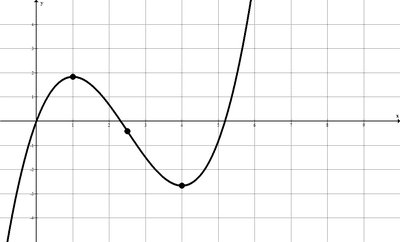
Example: For the function shown below:
Increasing: ,
Decreasing:
Relative Maximum:
Relative Minimum:
Concave Up:
Concave Down:
Inflection Point:
First and Second Derivative Tests, Curve Sketching
Tests for Local Extreme Points and Inflection Points
The first derivative test and second derivative test are used to classify critical points and inflection points.
First Derivative Test: If and changes sign at , has a local max or min.
Second Derivative Test: If and , local max; if , local min.
Inflection Point: If and changes sign at .
5-Step Method for Curve Analysis:
Compute and
Find critical points ()
Classify points using derivative tests
Find inflection points ()
Determine intercepts, asymptotes, and end behavior
Example:
Critical Points: ,
(Local Max), (Local Min)
Inflection Point:
Values: , ,
Local Max: , Local Min: , Inflection Point:
