 Back
BackBusiness Calculus Exam 4 Review: Step-by-Step Guidance
Study Guide - Smart Notes
 Tailored notes based on your materials, expanded with key definitions, examples, and context.
Q1. Given \( \int_{3}^{5} f(x) \, dx = 7 \) and \( \int_{3}^{5} g(x) \, dx = 1 \), find \( \int_{3}^{5} [4f(x) - 2g(x)] \, dx \).
Background
Topic: Properties of Definite Integrals
This question tests your understanding of linearity in definite integrals, specifically how to combine and scale integrals.
Key Terms and Formulas
Linearity of integrals: \( \int_{a}^{b} [cf(x) + dg(x)] \, dx = c \int_{a}^{b} f(x) \, dx + d \int_{a}^{b} g(x) \, dx \)
Definite integral: Represents the net area under a curve between two points.
Step-by-Step Guidance
Identify the given values: \( \int_{3}^{5} f(x) \, dx = 7 \) and \( \int_{3}^{5} g(x) \, dx = 1 \).
Apply the linearity property: \( \int_{3}^{5} [4f(x) - 2g(x)] \, dx = 4 \int_{3}^{5} f(x) \, dx - 2 \int_{3}^{5} g(x) \, dx \).
Substitute the known values into the expression: \( 4 \times 7 - 2 \times 1 \).
Try solving on your own before revealing the answer!
Final Answer: 26
\( 4 \times 7 - 2 \times 1 = 28 - 2 = 26 \)
This uses the linearity property of definite integrals to combine the results.
Q2. Find the cost function if the marginal cost function is \( C'(x) = 10x - 7 \) and the fixed cost is $8.
Background
Topic: Marginal Cost and Integration
This question tests your ability to find a total cost function from a marginal cost function using integration, including fixed costs.
Key Terms and Formulas
Marginal cost: \( C'(x) \) is the derivative of the cost function.
Total cost function: \( C(x) \) is found by integrating \( C'(x) \).
Fixed cost: The constant added after integration.
Step-by-Step Guidance
Write the marginal cost function: \( C'(x) = 10x - 7 \).
Integrate \( C'(x) \) to find \( C(x) \): \( \int (10x - 7) \, dx \).
Apply the integration: \( 10 \int x \, dx - 7 \int dx \).
Include the fixed cost as the constant of integration: Add $8 to the result.
Try solving on your own before revealing the answer!
Final Answer: \( C(x) = 5x^2 - 7x + 8 \)
Integrating \( 10x \) gives \( 5x^2 \), integrating \( -7 \) gives \( -7x \), and the fixed cost is added as $8.
Q3. Identify the rectangles shown in the graph as left rectangles, right rectangles, or neither. Determine whether the area to be calculated would be overestimated or underestimated.
Background
Topic: Riemann Sums and Approximation
This question tests your ability to recognize types of Riemann sum approximations and their effect on estimating area under a curve.
Key Terms and Formulas
Left rectangles: Use the left endpoint of each subinterval.
Right rectangles: Use the right endpoint of each subinterval.
Overestimate/Underestimate: Depends on whether the function is increasing or decreasing.
Step-by-Step Guidance
Examine the placement of the rectangles relative to the curve in the provided graph.
Determine if the height of each rectangle is determined by the left or right endpoint of each interval.
Assess whether the rectangles are above or below the curve to decide if the area is overestimated or underestimated.
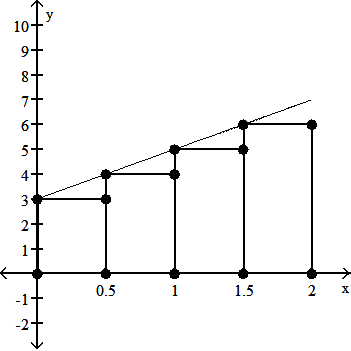
Try solving on your own before revealing the answer!
Final Answer: Left rectangles; area is underestimated.
The rectangles use the left endpoint, and since the function is increasing, the area is underestimated.
Q4. Identify the rectangles shown in the graph as left rectangles, right rectangles, or neither. Determine whether the area to be calculated would be overestimated or underestimated.
Background
Topic: Riemann Sums and Approximation
This question tests your ability to recognize types of Riemann sum approximations and their effect on estimating area under a curve.
Key Terms and Formulas
Left rectangles: Use the left endpoint of each subinterval.
Right rectangles: Use the right endpoint of each subinterval.
Overestimate/Underestimate: Depends on whether the function is increasing or decreasing.
Step-by-Step Guidance
Examine the placement of the rectangles relative to the curve in the provided graph.
Determine if the height of each rectangle is determined by the left or right endpoint of each interval.
Assess whether the rectangles are above or below the curve to decide if the area is overestimated or underestimated.
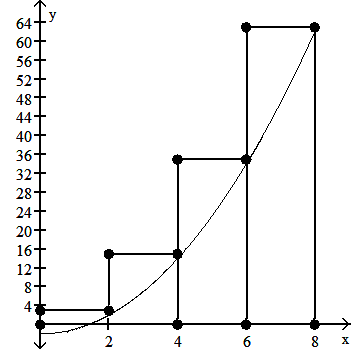
Try solving on your own before revealing the answer!
Final Answer: Right rectangles; area is overestimated.
The rectangles use the right endpoint, and since the function is increasing, the area is overestimated.
Q5. Set up a definite integral that represents the shaded area under \( y = g(x) \).
Background
Topic: Definite Integrals and Area Under a Curve
This question tests your ability to translate a shaded region under a curve into a definite integral.
Key Terms and Formulas
Definite integral: \( \int_{a}^{b} g(x) \, dx \) represents the area under \( g(x) \) from \( x = a \) to \( x = b \).
Step-by-Step Guidance
Identify the interval over which the area is shaded (from the graph, typically \( x = 1 \) to \( x = 2 \)).
Write the definite integral: \( \int_{1}^{2} g(x) \, dx \).
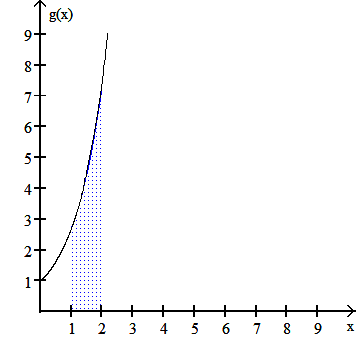
Try solving on your own before revealing the answer!
Final Answer: \( \int_{1}^{2} g(x) \, dx \)
This integral represents the area under \( g(x) \) from \( x = 1 \) to \( x = 2 \).
Q6. Set up a definite integral that represents the shaded area under \( y = h(x) \).
Background
Topic: Definite Integrals and Area Under a Curve
This question tests your ability to translate a shaded region under a curve into a definite integral.
Key Terms and Formulas
Definite integral: \( \int_{a}^{b} h(x) \, dx \) represents the area under \( h(x) \) from \( x = a \) to \( x = b \).
Step-by-Step Guidance
Identify the interval over which the area is shaded (from the graph, typically \( x = 0 \) to \( x = 2 \)).
Write the definite integral: \( \int_{0}^{2} h(x) \, dx \).
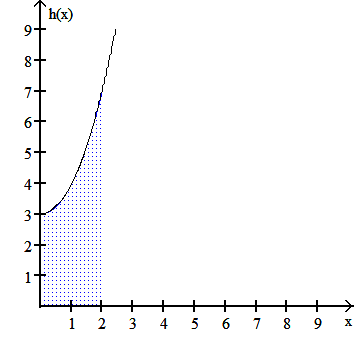
Try solving on your own before revealing the answer!
Final Answer: \( \int_{0}^{2} h(x) \, dx \)
This integral represents the area under \( h(x) \) from \( x = 0 \) to \( x = 2 \).
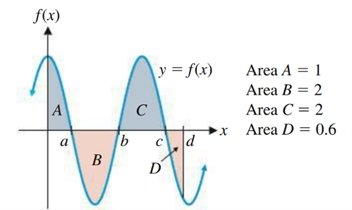
Q13. Refer to the figure below. Find the value of the requested definite integrals.
Background
Topic: Definite Integrals and Area Interpretation
This question tests your ability to interpret definite integrals as areas under a curve, including positive and negative regions.
Key Terms and Formulas
Definite integral: \( \int_{a}^{b} f(x) \, dx \) is the net area between \( f(x) \) and the x-axis from \( x = a \) to \( x = b \).
Areas above the x-axis are positive; below are negative.
Step-by-Step Guidance
Identify the labeled areas (A, B, C, D) and their values from the figure.
For each integral, sum the areas, considering their sign (positive above, negative below).
For example, \( \int_{a}^{b} f(x) \, dx \) would be area A minus area B.
Try solving on your own before revealing the answer!
Final Answer: a) -10, b) -0.4, c) -0.6, d) -1
Each integral is calculated by summing the signed areas as indicated in the figure.
