 Back
BackBusiness Calculus: Limits Practice and Graphical Analysis
Study Guide - Smart Notes
 Tailored notes based on your materials, expanded with key definitions, examples, and context.
Q1. Evaluate the following limit:
Background
Topic: Limits of Polynomial Functions
This question tests your understanding of how to evaluate the limit of a polynomial function as approaches a specific value. For polynomials, limits can usually be found by direct substitution.
Key Terms and Formulas:
Limit: The value that a function approaches as the input approaches a certain value.
Polynomial: An expression involving powers of with constant coefficients.
Step-by-Step Guidance
Identify the function: .
Since this is a polynomial, you can substitute directly into the function.
Calculate , , and add $5$.
Add the results together to get the value the function approaches as approaches .
Try solving on your own before revealing the answer!
Q2. Evaluate the following limit:
Background
Topic: Limits Involving Rational Functions
This question tests your ability to evaluate limits of rational functions, especially when the denominator may be zero at the point of interest.
Key Terms and Formulas:
Rational Function: A function of the form where and are polynomials.
Factoring: Sometimes, you need to factor the denominator and numerator to simplify the expression.
Step-by-Step Guidance
Factor the denominator: .
Notice that the numerator is , which matches one factor in the denominator.
Simplify the expression by canceling common factors, if possible.
After simplification, substitute into the remaining expression to evaluate the limit.
Try solving on your own before revealing the answer!
Q3. Evaluate the following limit:
Background
Topic: Limits with Quadratic Denominators
This question tests your ability to evaluate limits where the denominator becomes zero, which may result in an infinite limit or undefined value.
Key Terms and Formulas:
Quadratic: A polynomial of degree 2.
Infinite Limit: If the denominator approaches zero and the numerator is nonzero, the limit may be infinite.
Step-by-Step Guidance
Factor the denominator: .
Substitute into the denominator to see if it becomes zero.
Analyze the behavior of the function as approaches from both sides.
Determine if the limit approaches , , or does not exist.
Try solving on your own before revealing the answer!
Q4. Evaluate the following limit:
Background
Topic: Limits Involving Square Roots
This question tests your ability to handle limits where substitution leads to an indeterminate form (like ), often requiring algebraic manipulation such as multiplying by the conjugate.
Key Terms and Formulas:
Indeterminate Form: An expression like that requires further simplification.
Conjugate: For , the conjugate is .
Step-by-Step Guidance
Substitute to check if you get .
If so, multiply numerator and denominator by the conjugate of the denominator: .
Simplify the resulting expression to eliminate the square root in the denominator.
Substitute into the simplified expression to evaluate the limit.
Try solving on your own before revealing the answer!
Q5. Find the following limits graphically:
Background
Topic: Graphical Limits
This question tests your ability to interpret limits from a graph, including one-sided limits, infinite limits, and function values at specific points.
Key Terms and Concepts:
One-sided limits: (from the left), (from the right)
Function value: is the actual value of the function at (may differ from the limit)
Infinite limits: Behavior as approaches or
Removable/Jump Discontinuity: Where the limit exists but the function value is different or undefined
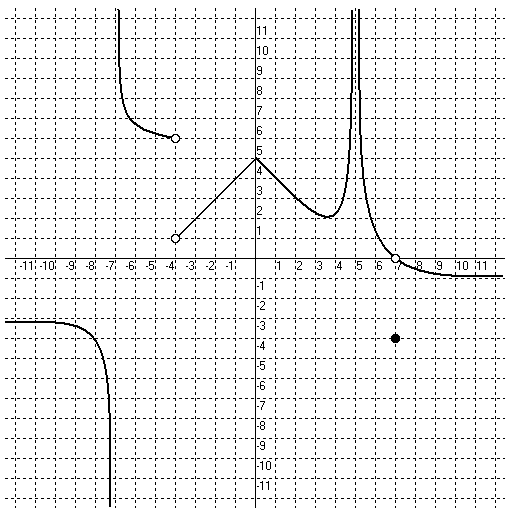
Step-by-Step Guidance
For each limit, locate the relevant -value on the graph.
For one-sided limits, observe the -value the function approaches as approaches from the left or right.
For , look for a filled dot at ; if there is an open circle, the function is not defined there.
For infinite limits, observe the end behavior of the graph as approaches or .
Compare the left and right limits at points of discontinuity to determine if the two-sided limit exists.
Try solving on your own before revealing the answer!
