 Back
BackBusiness Calculus Study Guidance: Continuity, Cost, Revenue, and Marginal Analysis
Study Guide - Smart Notes
 Tailored notes based on your materials, expanded with key definitions, examples, and context.
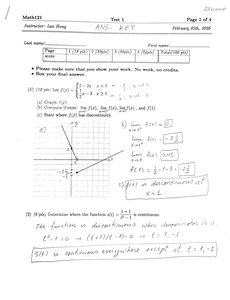
Q1. For the function defined piecewise, graph $f(x)$ and determine where it is not continuous.
Background
Topic: Continuity of Piecewise Functions
This question tests your understanding of continuity, especially for piecewise-defined functions. You need to identify points where the function is not continuous by analyzing the graph and the definition of .
Key Terms and Formulas:
Continuity: A function is continuous at if .
Piecewise Function: A function defined by different expressions for different intervals of .
Step-by-Step Guidance
Identify the intervals and expressions for from the piecewise definition.
Graph each segment of according to its formula and domain.
Check the endpoints where the formula changes (e.g., , ) for possible discontinuities.
For each endpoint, compare the left-hand and right-hand limits to the function value at that point.
Try solving on your own before revealing the answer!
Final Answer:
is continuous everywhere except at and .
At these points, the left and right limits do not match the function value, so discontinuities occur.
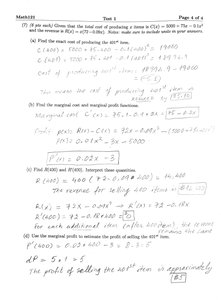
Q2. Given the total cost of producing items is and the revenue is , answer the following:
Background
Topic: Cost, Revenue, and Marginal Analysis
This question tests your ability to apply calculus concepts to business scenarios, specifically cost and revenue functions, marginal cost, and profit analysis.
Key Terms and Formulas:
Total Cost (): The total expense incurred in producing items.
Revenue (): The total income from selling items.
Marginal Cost: , the derivative of the cost function, representing the cost of producing one more item.
Marginal Revenue: , the derivative of the revenue function, representing the revenue from selling one more item.
Profit Function:
Step-by-Step Guidance
Write down the cost and revenue functions: , .
To find the cost of producing the 401st item, calculate .
Find the marginal cost by differentiating : .
Find the marginal revenue by differentiating : .
Set up the profit function: , and find the profit for selling the 401st item.
Try solving on your own before revealing the answer!
Final Answer:
The profit of selling the 401st item is approximately $5$.
This is found by calculating the difference between marginal revenue and marginal cost for the 401st item.
