Back
Business Calculus Study Guide: Derivative Techniques and Applications
Study Guide - Smart Notes
 Tailored notes based on your materials, expanded with key definitions, examples, and context.
Calculating the Derivative
Notations for the Derivative
The derivative of a function can be written in several ways, including f'(x), dy/dx, and D[f(x)]. These notations represent the rate of change of the function with respect to its variable.
Constant Rule
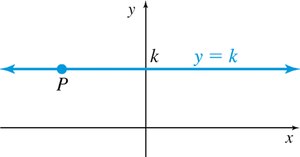
The Constant Rule states that the derivative of a constant function is zero. If f(x) = k where k is any real number, then:
Formula:
Example: The derivative of y = 5 is 0.
Power Rule
The Power Rule is used to differentiate functions of the form f(x) = x^n for any real number n. The rule states:
Formula:
Example: If f(x) = x^3, then .
Constant Times a Function Rule
If k is a real number and f(x) is a differentiable function, then:
Formula:
Example: The derivative of 5x^2 is .
Sum or Difference Rule
The derivative of a sum or difference of functions is the sum or difference of their derivatives:
Formula:
Formula:
Example: The derivative of x^2 + 3x is .
Using a Graphing Calculator for Derivatives
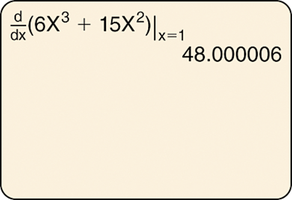
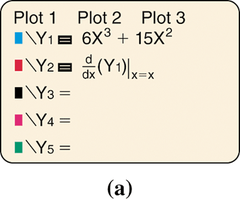
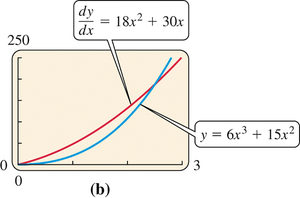
Graphing calculators can be used to compute and visualize derivatives. For example, calculating at x = 1 yields 48.
Applications of Derivatives in Business
Marginal Analysis
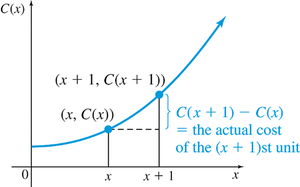
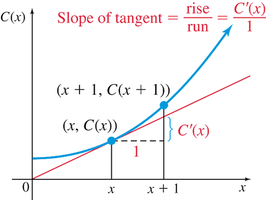
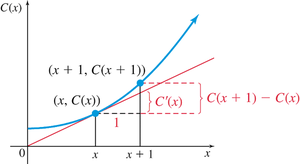
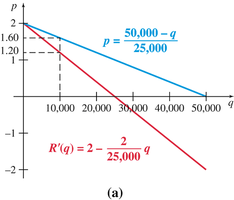
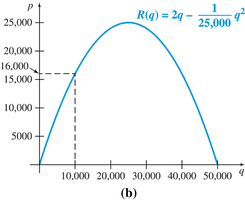
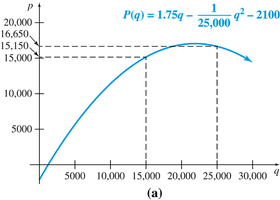
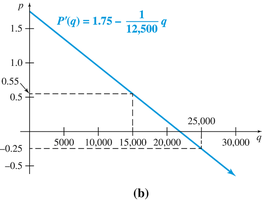
Marginal analysis uses derivatives to estimate the change in cost, revenue, or profit when producing one additional unit. The marginal cost, revenue, or profit is the derivative of the respective function.
Marginal Cost: estimates the cost of producing one more unit.
Marginal Revenue: estimates the additional revenue from selling one more unit.
Marginal Profit: estimates the additional profit from selling one more unit.
Techniques of Differentiation
Product Rule
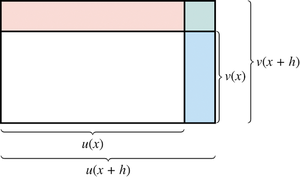
The Product Rule is used to differentiate products of two functions. If u(x) and v(x) are differentiable, then:
Formula:
Example: If u(x) = x^2 and v(x) = e^x, then .
Quotient Rule
The Quotient Rule is used to differentiate quotients of two functions. If u(x) and v(x) are differentiable and v(x) \neq 0, then:
Formula:
Example: If u(x) = x^2 and v(x) = x + 1, then .
Marginal Average Cost
If the total cost to manufacture x items is C(x), the average cost per item is A(x) = \frac{C(x)}{x}. The marginal average cost is the derivative of the average cost function:
Formula:
The Chain Rule
Composition of Functions
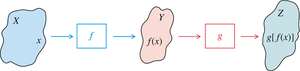
The composition of two functions f and g is written as g(f(x)). The chain rule is used to differentiate composite functions.
Chain Rule
If y = f(u) and u = g(x), then:
Formula:
Example: If y = (3x + 2)^4, then .
General Power Rule
If u(x) is a function of x and n is any real number:
Formula:
Derivatives of Exponential Functions
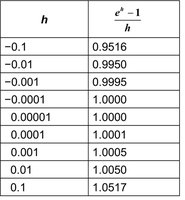
Approximating the Derivative of
The derivative of can be approximated using difference quotients. The table below shows values of for various :
h | |
|---|---|
-0.1 | 0.9516 |
-0.01 | 0.9950 |
-0.001 | 0.9995 |
-0.0001 | 1.0000 |
0.00001 | 1.0000 |
0.0001 | 1.0001 |
0.001 | 1.0005 |
0.01 | 1.0050 |
0.1 | 1.0517 |
Derivative of Exponential Functions
The derivative of an exponential function is:
Formula: for any positive constant a
Formula:
Formula (with chain rule):
Formula (with chain rule):
Derivatives of Logarithmic Functions
Derivative of Logarithmic Functions
The derivative of a logarithmic function is:
Formula:
Formula:
Formula (with chain rule):
Formula (with chain rule):
Extended Application: Electric Potential and Electric Field
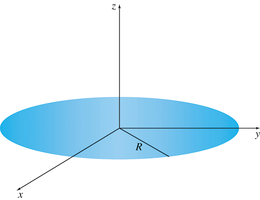
Electric Potential and Electric Field of a Charged Disc
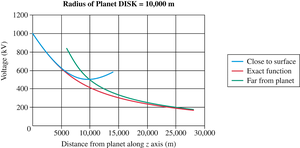
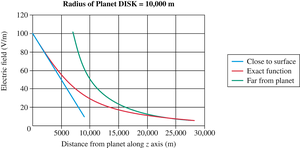
Calculus can be applied to physics, such as finding the electric potential and field of a charged disc. These applications involve integration and differentiation of functions describing physical quantities.