 Back
BackBusiness Calculus Study Guide: Exponential Growth, Decay, Derivatives, and Optimization
Study Guide - Smart Notes
 Tailored notes based on your materials, expanded with key definitions, examples, and context.
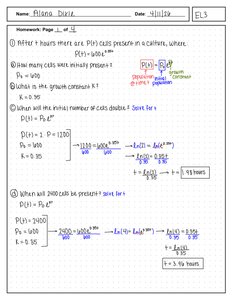
Q1. After t hours there are P(t) cells present in a culture, where P(t) = 600e0.08t.
Background
Topic: Exponential Growth Models
This question tests your understanding of exponential growth, initial value, and growth constant in population models.
Key Terms and Formulas
Exponential growth formula:
= initial population
= growth constant
= time (hours)
Step-by-Step Guidance
Identify the initial population by evaluating .
Determine the growth constant by comparing the formula to .
To find when the cell count doubles, set and solve for .
To find when , set up the equation and solve for using logarithms.
Try solving on your own before revealing the answer!
Final Answer:
Initial population: 600 cells
Growth constant: 0.08
Time to double: 8.66 hours
Time to reach 2400 cells: 18.32 hours
These results are found by plugging values into the exponential growth formula and solving for using logarithms.
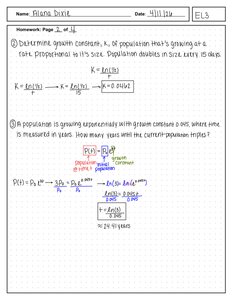
Q2. Determine growth constant k for a population that doubles every 16 days.
Background
Topic: Exponential Growth Rate Calculation
This question tests your ability to calculate the growth constant when given doubling time.
Key Terms and Formulas
Doubling time formula: , where is the doubling time.
Step-by-Step Guidance
Set and substitute into the exponential formula.
Take the natural logarithm of both sides to solve for .
Plug in days and calculate .
Try solving on your own before revealing the answer!
Final Answer:
Growth constant
This is calculated using .
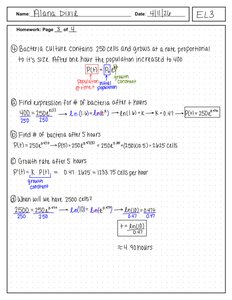
Q3. Bacteria culture contains 250 cells and grows at a rate proportional to its size. After one hour, the population increases to 400.
Background
Topic: Exponential Growth, Initial Value, and Rate Calculation
This question tests your ability to set up and solve exponential growth equations given initial and subsequent values.
Key Terms and Formulas
Exponential growth:
Given ,
Step-by-Step Guidance
Set up the equation and solve for using logarithms.
Write the general expression for using the calculated .
To find the number of cells after 5 hours, substitute into .
To find the growth rate after 5 hours, differentiate and evaluate at .
Try solving on your own before revealing the answer!
Final Answer:
Growth constant
Expression:
Cells after 5 hours: 3455
Growth rate after 5 hours: 1623 cells/hour
Time to reach 2500 cells: 4.99 hours
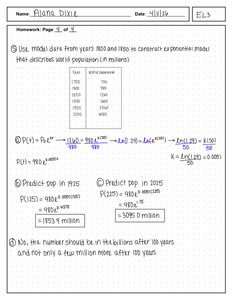
Q4. Use model data from years 1800 and 1950 to construct exponential model for world population (in millions).
Background
Topic: Exponential Modeling Using Data
This question tests your ability to use two data points to construct an exponential model and make predictions.
Key Terms and Formulas
Exponential model:
Use two points: and
Solve for using
Step-by-Step Guidance
Identify and using the data from 1800 and 1950.
Write the exponential model .
Predict population for given years by substituting into .
Try solving on your own before revealing the answer!
Final Answer:
Model:
Predicted population in 1975: 1953 million
Predicted population in 2005: 3095 million
Model shows population in billions after 100 years, not just a few million more.
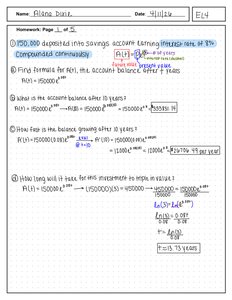
Q5. $150,000 deposited into savings account earning interest rate of 4.7% compounded continuously. Find formula for A(t), account balance after t years.
Background
Topic: Continuous Compounding Interest
This question tests your understanding of exponential growth in financial contexts.
Key Terms and Formulas
Continuous compounding formula:
= principal (initial deposit)
= interest rate (as decimal)
= time (years)
Step-by-Step Guidance
Write the formula for using the given values.
To find the balance after 10 years, substitute .
To find the growth rate after 10 years, differentiate and evaluate at .
To find how long until the account reaches , set and solve for using logarithms.
Try solving on your own before revealing the answer!
Final Answer:
Formula:
Balance after 10 years:
Growth rate after 10 years: per year
Time to reach : 33.73 years
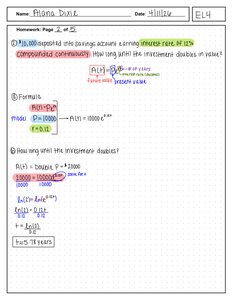
Q6. $10,000 deposited into savings account earning interest rate of 4.7% compounded continuously. How long until the investment doubles in value?
Background
Topic: Doubling Time for Continuous Compounding
This question tests your ability to solve for time when the investment doubles using continuous compounding.
Key Terms and Formulas
Continuous compounding:
Doubling time:
Step-by-Step Guidance
Set and substitute into the formula.
Take the natural logarithm of both sides to solve for .
Plug in and calculate .
Try solving on your own before revealing the answer!
Final Answer:
Doubling time: 14.75 years
This is calculated using .
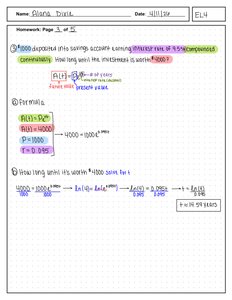
Q7. $4000 deposited into savings account earning interest rate of 4.5% compounded continuously. How long until the investment is worth $8000?
Background
Topic: Continuous Compounding and Doubling Value
This question tests your ability to solve for time when the investment doubles using continuous compounding.
Key Terms and Formulas
Continuous compounding:
Doubling time:
Step-by-Step Guidance
Set and in the formula.
Take the natural logarithm of both sides to solve for .
Plug in and calculate .
Try solving on your own before revealing the answer!
Final Answer:
Doubling time: 15.41 years
This is calculated using .
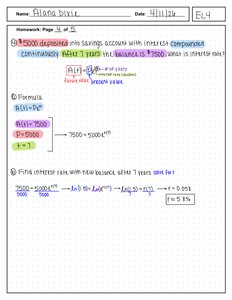
Q8. $7500 deposited into savings account with interest compounded continuously. After 7 years, the balance is $9500. Find interest rate.
Background
Topic: Solving for Interest Rate in Continuous Compounding
This question tests your ability to solve for the interest rate given initial and final values and time.
Key Terms and Formulas
Continuous compounding:
Given ,
Step-by-Step Guidance
Set up the equation .
Take the natural logarithm of both sides to solve for .
Calculate using the values provided.
Try solving on your own before revealing the answer!
Final Answer:
Interest rate: 3.51%
This is calculated using .
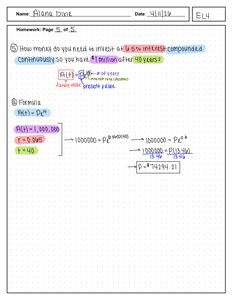
Q9. How much do you need to invest at 6.5% interest compounded continuously so you have $1 million after 40 years?
Background
Topic: Present Value for Continuous Compounding
This question tests your ability to solve for the initial investment needed to reach a future value.
Key Terms and Formulas
Continuous compounding:
Given ,
Step-by-Step Guidance
Set up the equation .
Take the natural logarithm of both sides to solve for .
Calculate using the values provided.
Try solving on your own before revealing the answer!
Final Answer:
Initial investment needed: $74,149.21
This is calculated using .
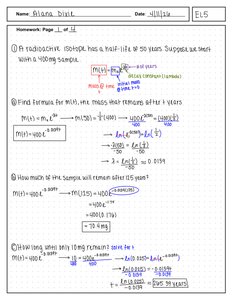
Q10. A radioactive isotope has a half-life of 50 years. Suppose we start with a 400g sample.
Background
Topic: Exponential Decay and Half-Life
This question tests your understanding of exponential decay and how to use half-life to model radioactive decay.
Key Terms and Formulas
Decay formula:
Half-life formula:
= initial mass
Step-by-Step Guidance
Calculate using the half-life formula.
Write the decay formula for .
To find mass after 40 years, substitute into .
To find how much remains after 150 years, substitute .
To find how long until only 10g remains, set and solve for using logarithms.
Try solving on your own before revealing the answer!
Final Answer:
Decay constant
Mass after 40 years: 144g
Mass after 150 years: 50g
Time to reach 10g: 263.5 years
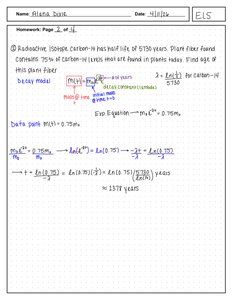
Q11. Radioactive isotope Carbon-14 has half-life of 5730 years. Plant fiber found contains 75% of carbon-14 levels found in living plants. Find age of this plant fiber.
Background
Topic: Radioactive Decay and Carbon Dating
This question tests your ability to use exponential decay to estimate the age of a sample based on remaining isotope.
Key Terms and Formulas
Decay formula:
Half-life formula:
Given
Step-by-Step Guidance
Calculate using the half-life formula.
Set up the equation and solve for using logarithms.
Plug in the values and calculate .
Try solving on your own before revealing the answer!
Final Answer:
Age of plant fiber: 1371 years
This is calculated using .
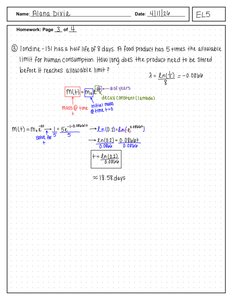
Q12. Iodine-131 has half-life of 8 days. A food product has 5 times the allowable limit for human consumption. How long does the product need to be stored before it reaches allowable limit?
Background
Topic: Radioactive Decay and Safety Limits
This question tests your ability to use exponential decay to determine safe storage times for radioactive substances.
Key Terms and Formulas
Decay formula:
Half-life formula:
Given
Step-by-Step Guidance
Calculate using the half-life formula.
Set up the equation and solve for using logarithms.
Plug in the values and calculate .
Try solving on your own before revealing the answer!
Final Answer:
Storage time: 13.58 days
This is calculated using .
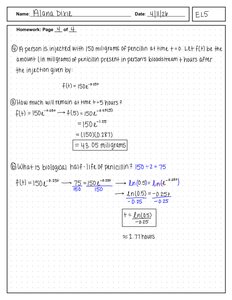
Q13. A person is injected with 150 milligrams of penicillin at time t = 0. Let F(t) be the amount (in mg) of penicillin present in person's bloodstream t hours after injection.
Background
Topic: Exponential Decay in Biological Systems
This question tests your ability to model drug decay and calculate biological half-life.
Key Terms and Formulas
Decay formula:
Biological half-life:
Given mg
Step-by-Step Guidance
Set up the decay formula for penicillin.
To find how much remains after 3 hours, substitute .
To find biological half-life, set and solve for using logarithms.
Try solving on your own before revealing the answer!
Final Answer:
Amount after 3 hours: 43.05 mg
Biological half-life: 1.77 hours
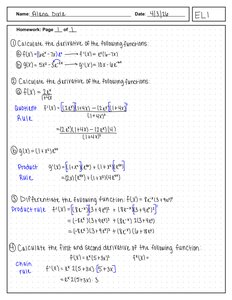
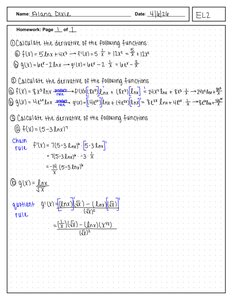
Q14. Calculate the derivative of the following functions.
Background
Topic: Differentiation Rules (Product, Quotient, Chain)
This question tests your ability to apply differentiation rules to various functions.
Key Terms and Formulas
Product Rule:
Quotient Rule:
Chain Rule:
Step-by-Step Guidance
Identify which rule applies to each function.
Apply the rule step-by-step, writing out derivatives of each part.
Combine terms as needed, but stop before simplifying to the final answer.
Try solving on your own before revealing the answer!
Final Answer:
Derivatives calculated using appropriate rules for each function.
See worksheet for detailed steps and results.
Q15. Find the absolute max and min values of the following function on the closed interval [-3,1]: f(x) = x^2 + x + 18
Background
Topic: Optimization on Closed Intervals
This question tests your ability to find critical points and evaluate endpoints to determine absolute extrema.
Key Terms and Formulas
Critical points: where or DNE
Evaluate at critical points and endpoints
Step-by-Step Guidance
Find and solve for critical points.
Evaluate at critical points and endpoints.
Compare values to determine absolute max and min.
Try solving on your own before revealing the answer!
Final Answer:
Absolute max: 27 at
Absolute min: 18 at
