 Back
BackBusiness Calculus Study Guide: Integration and Applications
Study Guide - Smart Notes
 Tailored notes based on your materials, expanded with key definitions, examples, and context.
Chapter 5 - Integration
Antiderivatives and Indefinite Integrals
The concept of antiderivatives is fundamental in calculus, representing the reverse operation of differentiation. Indefinite integrals generalize antiderivatives, providing a family of functions differing by a constant.
Antiderivative: If F'(x) = f(x), then F(x) is an antiderivative of f(x).
Indefinite Integral: The set of all antiderivatives of f(x) is denoted by .
Constant of Integration: Any two antiderivatives differ by a constant, .
Basic Indefinite Integral Formulas:
,
Example: Find an antiderivative for . One solution is .
Integration by Substitution
Integration by substitution is a technique used to evaluate integrals of more complex functions, essentially applying the chain rule in reverse.
Substitution: If , then .
Tips for Choosing u:
u should simplify the integral.
u is often an "inside function" or appears in the denominator.
The derivative of u, or a multiple of it, should appear in the integral.
Example: To integrate , let , then .
5.4 - The Definite Integral
Definite Integrals and Area Under a Curve
Definite integrals are used to calculate the exact area under a curve between two points, which has applications in physics, statistics, and economics.
Definite Integral: represents the area under f(x) from x = a to x = b.
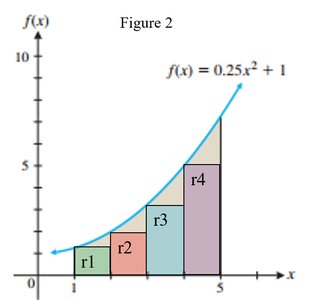
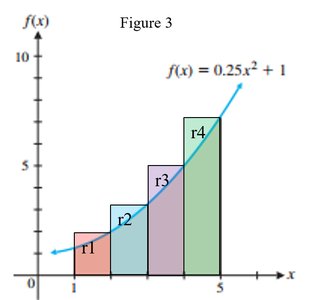
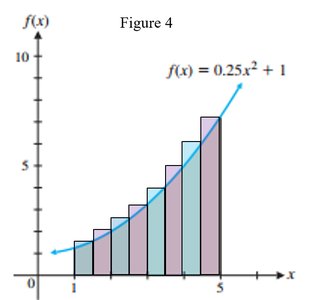
Riemann Sums: Approximates area by summing rectangles under the curve. As the number of rectangles increases, the approximation improves.
Properties:
Example: Calculate the area under m/s from to seconds.
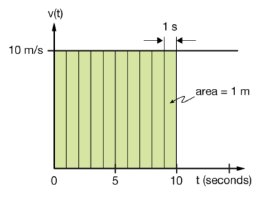
Riemann Sum Visualization: Approximating area under using rectangles.
The Fundamental Theorem of Calculus
The Fundamental Theorem of Calculus links differentiation and integration, allowing definite integrals to be evaluated using antiderivatives.
Theorem: If F is an antiderivative of f, then .
Application: Use the simplest antiderivative (set C = 0) for calculation.
Example: Evaluate .
Average Value of a Function
The average value of a continuous function f over [a, b] is given by:
Example: Find the average price over a demand interval using integration.
Chapter 6 - Additional Integration Topics
Area Between Curves
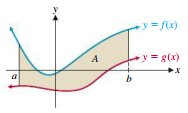
Calculating the area between two curves is a common application of definite integrals. The area is found by subtracting the lower curve from the upper curve over the interval.
Signed Area: Area above the x-axis minus area below the x-axis.
Area Between Two Curves: where .
Example: Find the area between and from to .
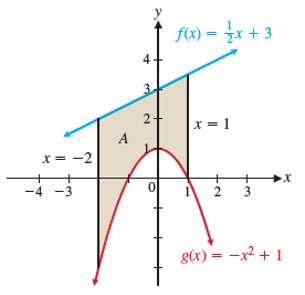
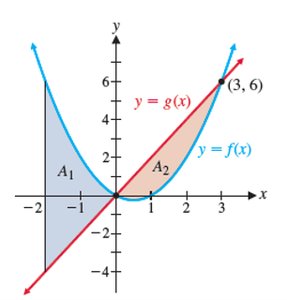
Example: Find the area bounded by and for .
Integration Applications in Business & Economics
Integration is used in business and economics to analyze income distribution, calculate total income, and determine consumer and producer surplus.
Lorenz Curve: Graphical representation of income inequality. The Gini Index quantifies income concentration.
Gini Index:
Example: Calculate the Gini Index for a given Lorenz curve.

Continuous Income Stream: Total income over time is .
Future Value:
Consumer Surplus:
Producer Surplus:
Example: Find equilibrium price and surplus for and .
Probability Density Functions
Probability density functions (PDFs) are used to model continuous random variables. The area under the PDF curve over an interval gives the probability of outcomes in that interval.
Conditions for a PDF:
f(x) ≥ 0 for all x
The total area under f(x) is 1
Probability over [c, d] is
Example: Find the probability that a phone call lasts between 2 and 3 minutes using for .
