 Back
BackBusiness Calculus Study Guide: Limits, Derivatives, and Applications
Study Guide - Smart Notes
 Tailored notes based on your materials, expanded with key definitions, examples, and context.
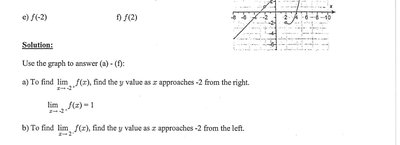
Q1. Use the graph of shown to find the following limits and function values:
a)
b)
c)
d)
e)
f)
Background
Topic: Limits and Function Values from Graphs
This question tests your ability to interpret limits and function values using a graph, including one-sided limits and whether a limit exists at a point.
Key Terms and Formulas:
One-sided limits: (right-hand limit), (left-hand limit)
Limit at a point: exists if both one-sided limits are equal
Function value: is the value of the function at
Step-by-Step Guidance
Examine the graph at and to determine the behavior of as approaches these points from the left and right.
For one-sided limits, observe the y-value the graph approaches as gets close to the point from either side.
For the two-sided limit, check if the left and right limits are equal. If not, the limit does not exist.
For function values, look for the y-value at the exact value (may be a filled or open dot).
Try solving on your own before revealing the answer!
Final Answer:
a) b) c) d) does not exist e) f)
The limits at are equal, so the limit exists. At , the left and right limits are not equal, so the limit does not exist. Function values are found by checking the graph at the exact value.
Q2. Find the following for the given piecewise function:
a)
b)
c)
d)
Background
Topic: Limits and Function Values for Piecewise Functions
This question tests your understanding of evaluating limits and function values for piecewise-defined functions, especially at the boundary where the definition changes.
Key Terms and Formulas:
Piecewise function: Different formulas for different intervals of
One-sided limits: Use the formula valid for approaching from each side
Limit at a point: Exists if both one-sided limits are equal
Step-by-Step Guidance
For , use the formula for .
For , use the formula for and substitute .
For , use the formula for and substitute .
Compare the one-sided limits to determine if exists.
Try solving on your own before revealing the answer!
Final Answer:
a) b) c) d) does not exist
The function value and one-sided limits are found by substituting into the appropriate formulas. The limit does not exist because the one-sided limits are not equal.
Q3. Find the value for so that exists for:
Background
Topic: Continuity and Limits for Piecewise Functions
This question tests your ability to find a parameter value that makes a piecewise function continuous at a boundary point.
Key Terms and Formulas:
Limit at a boundary: and must be equal
Set the two expressions equal and solve for the unknown parameter
Step-by-Step Guidance
Find by substituting into the first formula.
Find by substituting into the second formula.
Set the two limits equal and solve for .
Try solving on your own before revealing the answer!
Final Answer:
Setting the left and right limits equal ensures the function is continuous at .
Q4. The total number of people, , infected with a contagious virus weeks after the epidemic began is given by a function. Complete the table and answer related questions.
Background
Topic: Function Evaluation and Limits in Applications
This question tests your ability to evaluate a function at given values and interpret the limiting behavior in a real-world context.
Key Terms and Formulas:
Function evaluation: Substitute values into
Limit: What value approaches as increases
Step-by-Step Guidance
Substitute each value into the function to fill out the table.
Observe the trend in as increases.
Interpret the limiting value as becomes large.
Try solving on your own before revealing the answer!
Final Answer:
The table is completed with values for each . As $t$ increases, $P$ approaches 1540.
This shows the limiting population infected as time goes on.
Q5. Find the following limits algebraically:
5.
6.
Background
Topic: Algebraic Techniques for Limits
This question tests your ability to simplify expressions to evaluate limits, especially when direct substitution gives an indeterminate form.
Key Terms and Formulas:
Indeterminate form: or
Factor and simplify, or rationalize numerator/denominator
Step-by-Step Guidance
Substitute the given value to check for indeterminate form.
If indeterminate, factor numerator and denominator or rationalize as needed.
Simplify the expression and then substitute the value again.
Try solving on your own before revealing the answer!
Final Answer:
5. 6.
Factoring and rationalizing allow you to resolve the indeterminate form and find the limit.
Q6. Find the limit as :
Background
Topic: Limits at Infinity for Rational Functions
This question tests your ability to find the limit of a rational function as approaches infinity by comparing degrees of numerator and denominator.
Key Terms and Formulas:
Highest degree terms dominate as
Divide numerator and denominator by
Step-by-Step Guidance
Identify the highest degree term in numerator and denominator.
Divide both by to simplify.
Take the limit as ; lower degree terms vanish.
Try solving on your own before revealing the answer!
Final Answer:
The limit is the ratio of the leading coefficients.
Q7. Given , find the following:
a)
b)
c)
d)
e) Is continuous at ?
Background
Topic: Continuity and Limits for Piecewise Functions
This question tests your ability to evaluate limits, function values, and continuity for piecewise functions at a boundary.
Key Terms and Formulas:
Continuity: is continuous at if
Step-by-Step Guidance
Find using the formula for .
Find one-sided limits using the appropriate formulas.
Check if the limits and function value are equal for continuity.
Try solving on your own before revealing the answer!
Final Answer:
a) b) c) d) does not exist e) is not continuous at
The function is not continuous at because the limits and function value are not all equal.
Q8. Let . Find a simplified form of the difference quotient (average rate of change), .
Background
Topic: Difference Quotient and Average Rate of Change
This question tests your ability to compute and simplify the difference quotient, which is foundational for understanding derivatives.
Key Terms and Formulas:
Difference quotient:
Step-by-Step Guidance
Compute by substituting into the function.
Subtract from .
Simplify the expression and divide by .
Try solving on your own before revealing the answer!
Final Answer:
This is the simplified form of the difference quotient for .
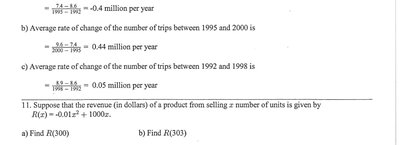
Q9. The graph shows the number of trips taken annually on a state's mass transportation system. Find the average rate of change of the number of trips between two years.
a) From 1992 to 1995
b) From 1995 to 2000
c) From 1992 to 1998
Background
Topic: Average Rate of Change from Data
This question tests your ability to use the slope formula to find the average rate of change from a graph or table.
Key Terms and Formulas:
Slope formula:
Step-by-Step Guidance
Identify the values (number of trips) and values (years) for each interval.
Apply the slope formula for each pair of years.
Round your answer to two decimal places if necessary.
Try solving on your own before revealing the answer!
Final Answer:
a) million per year b) million per year c) million per year
These are the average rates of change for each interval, calculated using the slope formula.
Q10. Suppose that the revenue (in dollars) of a product from selling units is given by . Find , , and the average rate of revenue as $x$ changes from 300 to 303.
Background
Topic: Function Evaluation and Average Rate of Change
This question tests your ability to evaluate a quadratic function and compute the average rate of change over an interval.
Key Terms and Formulas:
Function evaluation: Substitute values into
Average rate of change:
Step-by-Step Guidance
Substitute and into to find the values.
Subtract from .
Divide by the change in to find the average rate.
Try solving on your own before revealing the answer!
Final Answer:
a) b) c) d) per unit
The average rate of revenue is $994x$ changes from 300 to 303.
Q11. For the function , find by determining , and find .
Background
Topic: Derivative Definition and Evaluation
This question tests your ability to use the limit definition of the derivative and evaluate the derivative at a specific point.
Key Terms and Formulas:
Derivative definition:
Step-by-Step Guidance
Compute and , subtract, and divide by .
Simplify the expression and take the limit as .
Substitute into the derivative to find .
Try solving on your own before revealing the answer!
Final Answer:
The derivative is found using the limit definition, and is the slope at .
Q12. Find the derivative of .
Background
Topic: Derivative Rules
This question tests your ability to apply basic derivative rules to polynomial functions.
Key Terms and Formulas:
Power rule:
Step-by-Step Guidance
Apply the power rule to each term in the function.
Combine the results to get the derivative.
Try solving on your own before revealing the answer!
Final Answer:
Each term is differentiated separately and combined.
Q13. Find the derivative .
Background
Topic: Derivative Rules for Roots
This question tests your ability to rewrite root functions as exponents and apply the power rule.
Key Terms and Formulas:
Rewrite as and as
Power rule:
Step-by-Step Guidance
Rewrite the function using exponents.
Apply the power rule to each term.
Try solving on your own before revealing the answer!
Final Answer:
Roots are rewritten as exponents and differentiated using the power rule.
Q14. Find an equation of the tangent line to the graph of at the point .
Background
Topic: Tangent Line Equation
This question tests your ability to find the slope of the tangent line using the derivative and write the equation using point-slope form.
Key Terms and Formulas:
Derivative gives the slope at a point
Point-slope form:
Step-by-Step Guidance
Find to get the slope at .
Substitute into to find the slope.
Use the point-slope formula with and the slope.
Try solving on your own before revealing the answer!
Final Answer:
The tangent line equation is .
The slope is found using the derivative, and the equation is written using the point-slope form.
