 Back
Business Calculus Study Guide: Rates of Change, Marginal Cost, and Marginal Revenue
Study Guide - Smart Notes
 Tailored notes based on your materials, expanded with key definitions, examples, and context.
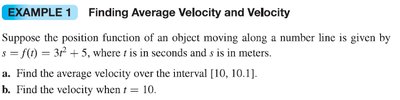
Q1. Finding Average Velocity and Velocity
Background
Topic: Average and Instantaneous Rate of Change (Velocity)
This question tests your understanding of how to compute the average velocity over a time interval and the instantaneous velocity at a specific time using a position function.
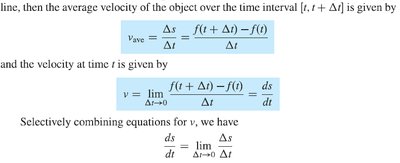
Key formulas:
Step-by-Step Guidance
Identify the position function: .
For part (a), calculate and to find the average velocity over .
Use the formula to set up the calculation.
For part (b), find the instantaneous velocity at by differentiating to get .
Set up using the derivative you found.
Try solving on your own before revealing the answer!
Final Answer:
(a) meters/second
(b) meters/second
The average velocity uses the difference quotient, while the instantaneous velocity uses the derivative.
Q2. Estimating Change in y Using dy/dx
Background
Topic: Linear Approximation and Rate of Change
This question tests your ability to estimate the change in a function using its derivative at a given point.
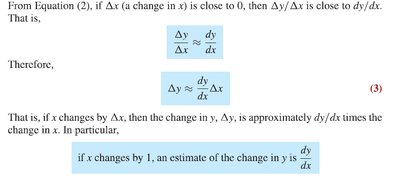

Key formula:
Step-by-Step Guidance
Identify the given derivative: at .
Determine the change in : .
Set up the estimation formula: .
Try solving on your own before revealing the answer!
Final Answer:
The estimated change in is 4 units when increases from 3 to 3.5.
Q3. Finding a Rate of Change
Background
Topic: Derivative and Rate of Change
This question tests your ability to find the rate of change of a function and evaluate it at specific points.

Key formula:
is the rate of change of with respect to .
Step-by-Step Guidance
Write the function: .
Find the derivative: .
Evaluate at and .
Try solving on your own before revealing the answer!
Final Answer:
; at , ; at , .
These values represent the rate of change of at the specified points.
Q4. Rate of Change of Price with Respect to Quantity
Background
Topic: Marginal Analysis in Economics
This question tests your ability to find the rate of change (marginal change) of price with respect to quantity using a demand function.

Key formula:
is the rate of change of price with respect to quantity.
Step-by-Step Guidance
Write the demand function: .
Find the derivative .
Evaluate at .
Try solving on your own before revealing the answer!
Final Answer:
; at ,
The price is decreasing at a rate of q = 5$.
Q5. Marginal Cost and Applications
Background
Topic: Marginal Cost in Economics
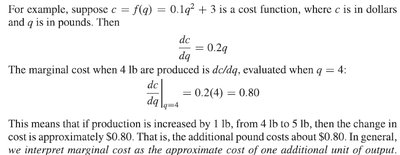
This question tests your understanding of how to compute marginal cost from a total-cost function and interpret its meaning.
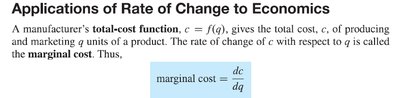
Key formula:
Step-by-Step Guidance
Write the cost function: .
Find the derivative .
Evaluate at .
Try solving on your own before revealing the answer!
Final Answer:
; at ,
The marginal cost at is $0.80 per pound.
Q6. Average Cost per Unit
Background
Topic: Average Cost Calculation
This question tests your ability to compute the average cost per unit and relate it to total cost.


Key formula:
Step-by-Step Guidance
Identify total cost and number of units .
Plug values into the formula .
Multiply both sides by to relate total cost and average cost.
Try solving on your own before revealing the answer!
Final Answer:
If and , then .
Total cost can be written as .
Q7. Marginal Cost from Average-Cost Equation
Background
Topic: Marginal Cost from Average Cost
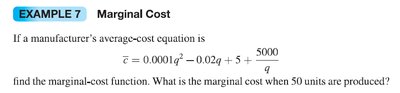
This question tests your ability to find the marginal cost function from an average-cost equation and evaluate it at a specific quantity.
Key formula:
Marginal cost:
Step-by-Step Guidance
Write the average-cost function.
Differentiate with respect to to find the marginal-cost function.
Evaluate the marginal-cost function at .
Try solving on your own before revealing the answer!
Final Answer:
Marginal-cost function: ; at , marginal cost is .
This value represents the rate of change of average cost at units.
Q8. Marginal Revenue
Background
Topic: Marginal Revenue in Economics
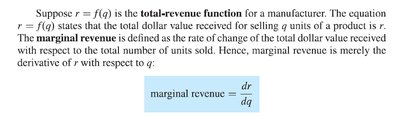
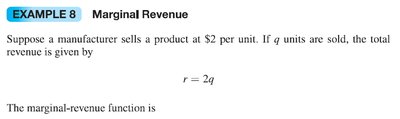
This question tests your understanding of how to compute marginal revenue from a total-revenue function.
Key formula:
Step-by-Step Guidance
Write the total-revenue function: .
Find the derivative .
Try solving on your own before revealing the answer!
Final Answer:
The marginal revenue is sold.
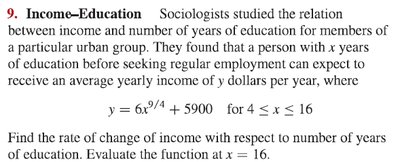
Q9. Income–Education: Rate of Change of Income
Background
Topic: Rate of Change in Applied Context
This question tests your ability to find the rate of change of income with respect to years of education and evaluate it at a specific value.
Key formula:
Rate of change:
Step-by-Step Guidance
Write the income function.
Find the derivative .
Evaluate at .
Try solving on your own before revealing the answer!
Final Answer:
; at ,
The rate of change of income at 16 years of education is $216$ dollars per year.
Q10. Marginal-Cost Function for Cost Functions
Background
Topic: Marginal Cost for Cost Functions
This question tests your ability to find the marginal-cost function and evaluate it at given values of .

Key formula:
Step-by-Step Guidance
Write the cost function for each problem.
Find the derivative .
Evaluate the marginal-cost function at the specified values of .
Try solving on your own before revealing the answer!
Final Answer:
For each cost function, differentiate with respect to and substitute the given values to find the marginal cost.
Q11. Marginal-Cost Function for Average Cost Functions
Background
Topic: Marginal Cost from Average Cost
This question tests your ability to find the marginal-cost function from an average-cost function and evaluate it at indicated values.

Key formula:
Step-by-Step Guidance
Write the average-cost function for each problem.
Find the derivative .
Evaluate the marginal-cost function at the specified values of .
Try solving on your own before revealing the answer!
Final Answer:
For each average-cost function, differentiate with respect to and substitute the given values to find the marginal cost.
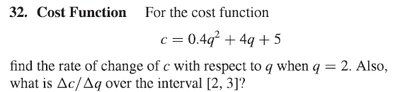
Q12. Cost Function: Rate of Change and Average Rate of Change
Background
Topic: Rate of Change and Average Rate of Change for Cost Functions
This question tests your ability to find the instantaneous and average rate of change for a cost function.
Key formula:
Instantaneous rate:
Average rate:
Step-by-Step Guidance
Write the cost function.
Find the derivative and evaluate at .
Calculate and , then set up the average rate formula.
Try solving on your own before revealing the answer!
Final Answer:
Instantaneous rate at :
Average rate over :
Q13. Approximating Total Cost Using Marginal and Average Cost
Background
Topic: Cost Approximation Using Marginal and Average Cost
This question tests your ability to use marginal and average cost to estimate total cost for a change in production.

Key formula:
Total cost for units:
Marginal cost approximates the cost of one additional unit.
Step-by-Step Guidance
Identify the average cost and marginal cost at .
Calculate total cost for 20 bikes: .
Add the marginal cost for the 21st bike to estimate total cost for 21 bikes.
Try solving on your own before revealing the answer!
Final Answer:
Total cost for 21 bikes is approximately $4150$.
This uses the average cost for the first 20 bikes and the marginal cost for the 21st bike.
