 Back
BackBusiness Calculus Study Notes: Nonlinear Functions and Quadratic Applications
Study Guide - Smart Notes
 Tailored notes based on your materials, expanded with key definitions, examples, and context.
Nonlinear Functions
Function Notation and Business Applications
Understanding function notation and its applications is fundamental in business calculus. Functions describe relationships between variables, such as cost, revenue, and profit.
Function Notation: The notation f(x) represents a function of x.
Example: If f(x) = 3 + x, then f(2) = 3 + 2 = 5.
Revenue Function: R(x) = p x, where p is price per unit and x is the number of units sold.
Break-Even Quantity: The value of x where R(x) = C(x) (revenue equals cost).
Profit Function: P(x) = R(x) - C(x).
Types of Functions
Business calculus often involves different types of functions, including linear, quadratic, and polynomial functions. Quadratic functions are especially important for modeling revenue, cost, and profit scenarios.
Quadratic Functions
Definition and Standard Form
A quadratic function is a nonlinear function of the form f(x) = ax^2 + bx + c, where a, b, and c are constants and a \neq 0. Quadratic functions graph as parabolas and are widely used in business applications.
Standard Form:
Example: For f(x) = 4x^2 + 3x - 9, a = 4, b = 3, c = -9.
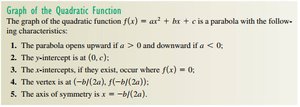
Graph of the Quadratic Function
The graph of a quadratic function has several key characteristics:
Direction: Opens upward if a > 0, downward if a < 0.
Y-intercept: Located at (0, c).
X-intercepts: Occur where f(x) = 0 (if they exist).
Vertex: The vertex is at .
Axis of Symmetry: The axis is .
Finding the Vertex
The vertex of a quadratic function is crucial for determining maximum or minimum values, which is important in business optimization problems.
Vertex Formula:
Example: For f(x) = 4x^2 + 3x - 9, the vertex is at .
Polynomial Functions
Definition and Structure
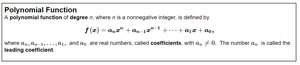
A polynomial function of degree n is defined as:
Coefficients: The numbers a_n, a_{n-1}, \ldots, a_0 are called coefficients.
Leading Coefficient: a_n is the leading coefficient and must not be zero.
Properties of Polynomial Functions
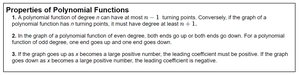
Polynomial functions have important properties that affect their graphs and business applications:
Turning Points: A polynomial of degree n can have at most n-1 turning points.
End Behavior: For even degree, both ends go up or down; for odd degree, one end goes up and one goes down.
Leading Coefficient: If positive, the graph rises as x increases; if negative, the graph falls.
Applications: Revenue Optimization
Management Science Example
Quadratic functions are used to model and optimize revenue in business scenarios. For example, adjusting price can affect the number of units sold and total revenue.
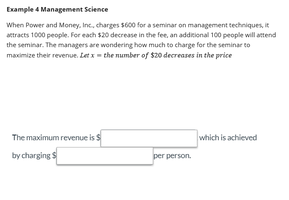
Scenario: A seminar charges $600 per person and attracts 1000 people. For each $20 decrease in price, 100 more people attend.
Variable: Let x be the number of $20 decreases in price.
Revenue Function: Revenue can be modeled as a quadratic function of x.
Maximum Revenue: The maximum revenue occurs at the vertex of the quadratic function.
Example Calculation: To find the maximum revenue, set up the revenue function and use the vertex formula to determine the optimal price and attendance.
Summary Table: Quadratic and Polynomial Function Properties
Function Type | Standard Form | Key Properties |
|---|---|---|
Quadratic | Parabola, vertex at , opens up/down, max/min value | |
Polynomial | Degree , up to turning points, end behavior depends on degree and leading coefficient |
Additional info: Academic context was added to clarify function types, business applications, and vertex calculation for optimization problems.
