 Back
BackBusiness Calculus Study Notes: Nonlinear Functions, Domain & Range, Rational Functions, Asymptotes, and Linear Systems
Study Guide - Smart Notes
 Tailored notes based on your materials, expanded with key definitions, examples, and context.
Nonlinear Functions and Function Basics
Function Notation and Evaluation
A function is a mathematical relationship where each input (usually x) has exactly one output (usually y). The notation f(x) denotes a function of x.
Example: If f(x) = 3 + x, then f(2) = 3 + 2 = 5.
Revenue Function: R(x) = p \times x, where p is price per unit and x is the number of units.
Break-Even Quantity: The x-value where revenue equals cost, R(x) = C(x).
Profit Function: P(x) = R(x) - C(x).
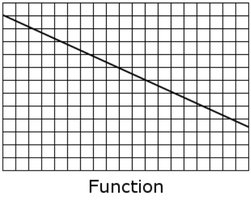
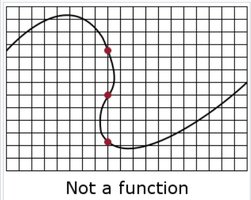
Vertical Line Test
The vertical line test is a visual method to determine if a graph represents a function. If any vertical line crosses the graph more than once, it is not a function.
Valid Function: A vertical line intersects the graph at only one point for each x-value.
Invalid Function: A vertical line intersects the graph at more than one point for some x-values.
Domain and Range of Functions
Domain
The domain of a function is the complete set of possible values for the independent variable (x) that produce real outputs.
The denominator of a fraction cannot be zero.
The value under a square root must be positive (for real numbers).
To find the domain, identify all x-values that are allowed in the function.
Range
The range of a function is the set of all possible output values (y) after substituting the domain values.
Find the minimum and maximum y-values by substituting x-values.
Check if y is always positive, negative, or restricted from certain values.
Sketching the graph can help visualize the range.
Interval Notation for Range
[a, b]: Both endpoints a and b are included.
(a, b): Endpoints a and b are not included.
{c}: Only the value c is included.
Rational Functions and Asymptotes
Rational Functions
A rational function is a function defined by the ratio of two polynomials, typically written as .
Asymptotes
An asymptote is a line that a graph approaches but never touches. There are three main types: vertical, horizontal, and oblique.
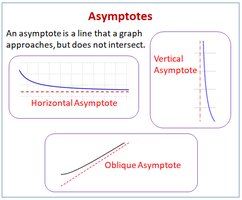
Vertical Asymptote: Occurs where the denominator of a rational function equals zero.
Horizontal Asymptote: Determined by comparing the degrees of the numerator and denominator.
Oblique Asymptote: Occurs when the degree of the numerator is one higher than the denominator.
Finding Horizontal Asymptotes
To determine the horizontal asymptote of a rational function, compare the degrees of the numerator and denominator:
If... | Then... |
|---|---|
The degree of the numerator < the degree of the denominator | There is a horizontal asymptote at y = 0 |
The degree of the numerator = the degree of the denominator | There is a horizontal asymptote at y = ratio of leading coefficients |
The degree of the numerator > the degree of the denominator | There is no horizontal asymptote |
Linear Functions and Systems
Linear Functions
A linear function is an equation that represents a straight line, typically written as .
Exponent, Power, Degree: These terms refer to the same concept; for example, in , the exponent, power, and degree are 4.
Linear Systems
A linear system is a collection of linear equations. Solving a linear system means finding values for the variables that satisfy all equations simultaneously.
Example: Solve the system:
Types of Solutions for Two Equations with Two Unknowns
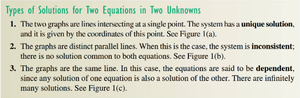
There are three possible types of solutions for a system of two linear equations:
Unique Solution: The two graphs intersect at a single point. The system is consistent and the solution is given by the coordinates of the intersection.
Inconsistent: The graphs are distinct parallel lines; there is no solution common to both equations.
Dependent: The graphs are the same line; any solution of one equation is also a solution of the other, resulting in infinitely many solutions.
Applications: Area Function and Domain
Rectangular Lot with Fencing
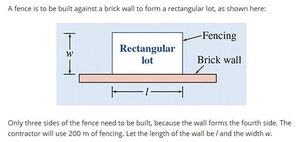
Consider a rectangular lot where a fence is to be built against a brick wall, forming three sides of the rectangle. The contractor uses a fixed amount of fencing, and the length of the wall is l, width is w.
Equation for Area: The area A as a function of length l is .
Constraint: The total fencing used is (since only three sides are fenced).
Domain: The domain consists of all positive values of l such that w is also positive and the total fencing does not exceed 200 m.
Summary Table: Horizontal Asymptotes
If... | Then... |
|---|---|
The degree of the numerator < the degree of the denominator | There is a horizontal asymptote at y = 0 |
The degree of the numerator = the degree of the denominator | There is a horizontal asymptote at y = ratio of leading coefficients |
The degree of the numerator > the degree of the denominator | There is no horizontal asymptote |
Recap
Use the vertical line test to determine if a graph is a function.
Domain: x-values (avoid zero in denominator and negative under square root).
Range: y-values (find minimum and maximum y).
Linear systems can have unique, inconsistent, or dependent solutions.
