 Back
BackBusiness Calculus Test 1 Study Guidance (Spring 2024)
Study Guide - Smart Notes
 Tailored notes based on your materials, expanded with key definitions, examples, and context.
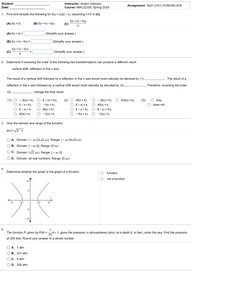
Q1. Find and simplify the following for f(x) = 22 - x, assuming h ≠ 0:
Background
Topic: Difference Quotient and Function Operations
This question tests your understanding of function evaluation, algebraic manipulation, and the difference quotient, which is foundational for calculus (especially for finding derivatives).
Key Terms and Formulas:
Difference Quotient:
Function evaluation: Substitute values into
Step-by-Step Guidance
Evaluate and using the given function .
For , substitute into the function: .
Set up the difference quotient: .
Simplify the numerator by combining like terms.
Try solving on your own before revealing the answer!
Final Answer:
The difference quotient simplifies to -1 for this linear function.
Q2. Determine if reversing the order of the following two transformations can produce a different result: vertical shift and reflection in the x-axis.
Background
Topic: Function Transformations
This question tests your understanding of how vertical shifts and reflections affect a function and whether the order of applying these transformations matters.
Key Terms and Formulas:
Vertical shift:
Reflection in x-axis:
Step-by-Step Guidance
Consider applying a vertical shift first: .
Then apply reflection: .
Now reverse the order: reflect first (), then shift ().
Compare the two resulting expressions to see if they are equivalent.
Try solving on your own before revealing the answer!
Final Answer:
Reversing the order does produce a different result: .
The vertical shift and reflection are not commutative; the order changes the outcome.
Q3. Give the domain and range of the function .
Background
Topic: Domain and Range of Linear Functions
This question tests your ability to identify the domain and range of a linear function.
Key Terms:
Domain: Set of all possible input values (x-values)
Range: Set of all possible output values (y-values)
Step-by-Step Guidance
Recognize that is a linear function.
Linear functions are defined for all real numbers, so the domain is all real numbers.
The range is also all real numbers because as varies, can take any value.
Try solving on your own before revealing the answer!
Final Answer:
Domain: ; Range:
Both domain and range are all real numbers for this linear function.
Q4. Determine whether the graph is a function.
Background
Topic: Function Identification (Vertical Line Test)
This question tests your ability to determine if a graph represents a function using the vertical line test.
Key Terms:
Function: Each input (x-value) corresponds to exactly one output (y-value).
Vertical Line Test: If any vertical line crosses the graph more than once, it is not a function.
Step-by-Step Guidance
Examine the graph and imagine drawing vertical lines at various x-values.
Check if any vertical line intersects the graph at more than one point.
If so, the graph is not a function; otherwise, it is a function.
Try solving on your own before revealing the answer!
Final Answer:
The graph is not a function because some vertical lines intersect the graph at more than one point.
Q5. The function is given by , is the pressure in atmospheres only, as a depth in feet, write the way that the pressure increases as the depth increases.
Background
Topic: Linear Functions and Real-World Interpretation
This question tests your ability to interpret a linear function in a real-world context (pressure as a function of depth).
Key Terms:
Linear function:
Interpretation: How does change as increases?
Step-by-Step Guidance
Identify the slope of the function ( increases by 1 for each unit increase in ).
Recognize the y-intercept (pressure starts at 7 when ).
Describe how pressure changes as depth increases.
Try solving on your own before revealing the answer!
Final Answer:
As depth () increases, pressure () increases linearly, starting from 7 atmospheres.
Each additional unit of depth increases the pressure by 1 atmosphere.
