 Back
BackChapter 5: Integration – The Definite Integral and Area Approximation
Study Guide - Smart Notes
 Tailored notes based on your materials, expanded with key definitions, examples, and context.
The Definite Integral
Introduction to the Definite Integral
The definite integral is a fundamental concept in calculus, used to compute areas, probabilities, average values of functions, and other quantities. It connects the process of finding antiderivatives (indefinite integrals) to the calculation of exact values for these quantities. The precise relationship between indefinite and definite integrals is established by the Fundamental Theorem of Calculus.
Definite Integral: Represents the accumulation of quantities, such as area under a curve, between two points.
Applications: Areas, probabilities, average values, and continuous income streams.
Notation: where f(x) is the integrand, a is the lower limit, and b is the upper limit.
Approximating Areas
Rectangular Approximation Methods
When the region under a curve does not conform to standard geometric shapes, we estimate its area using rectangles. This method allows us to approximate the area to any desired accuracy, though not exactly.
Left Sums: Use the function value at the left endpoint of each subinterval as the rectangle's height.
Right Sums: Use the function value at the right endpoint of each subinterval as the rectangle's height.
Increasing Functions: Left sums underestimate, right sums overestimate the area.
Example: Left and Right Sums
For the function f(x) = 0.25x^2 + 1 on the interval [1, 5], dividing into four equal subintervals:
Left Sum (L4):
Right Sum (R4):
Area Bounds:
Improving Approximations
Increasing the number of rectangles (subintervals) improves the accuracy of the area approximation. For example:
With 8 rectangles:
With 16 rectangles:
With 200 rectangles:
Computations with large numbers of rectangles are best performed using calculators or computers.
Error in Approximation
The error in an approximation is the absolute difference between the estimated and actual area. While the exact area and error are unknown, an error bound can be calculated to guarantee the error is below a certain threshold.
Error Bound Theorem: If f(x) is positive and monotonic on [a, b], then the error bound for left or right sums approaches zero as the number of rectangles increases.
The Definite Integral as a Limit of Sums
Riemann Sums
Left and right sums are special cases of Riemann sums, which generalize the approximation of areas using rectangles. The Riemann sum for a function f on [a, b] is:
Partition: Divide [a, b] into n subintervals of equal length .
Riemann Sum: where each is in .
Left Sum:
Right Sum:
For functions with positive values, each term in the Riemann sum represents the area of a rectangle above the x-axis.
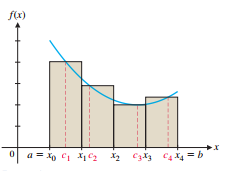
If the function has both positive and negative values, positive terms represent areas above the x-axis, and negative terms represent areas below the x-axis.
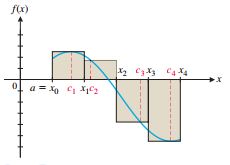
Example: Riemann Sum Calculation
For f(x) = 12 - x^2 on [2, 4], partitioned into four subintervals with midpoints:
Definition and Properties of the Definite Integral
Definition of the Definite Integral
If f is continuous on [a, b], the limit of Riemann sums as n approaches infinity exists and is called the definite integral:
Integrand: f(x)
Limits of Integration: a (lower), b (upper)
Geometric Interpretation
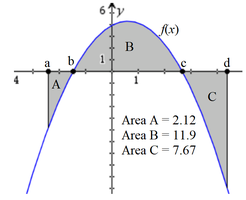
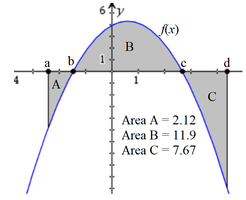
The definite integral represents the cumulative sum of signed areas between the graph of f and the x-axis from a to b. Areas above the x-axis are positive, and areas below are negative.
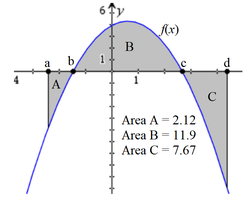
For example, if area A is below and area B is above the x-axis.
Example: Calculating the Definite Integral
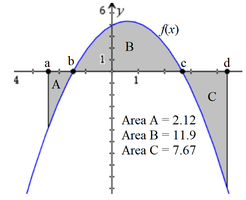
Refer to the figure for a function with areas A, B, and C:
Area A = 2.12 (below x-axis, negative)
Area B = 11.9 (above x-axis, positive)
Area C = 7.67 (below x-axis, negative)
Definite integral:
Properties of Definite Integrals
Basic Properties
The definite integral has several important properties that simplify calculations and allow for the combination and manipulation of integrals:
Linearity:
Additivity:
Reversal of Limits:
Zero Interval:
Example: Using Properties of the Definite Integral
These properties are used to simplify and solve definite integral problems, especially when dealing with piecewise functions or combining multiple intervals.
Example: If and , then .
