 Back
BackChapter 5: Integration – The Fundamental Theorem of Calculus and Applications
Study Guide - Smart Notes
 Tailored notes based on your materials, expanded with key definitions, examples, and context.
Integration
The Fundamental Theorem of Calculus
The Fundamental Theorem of Calculus establishes the connection between differentiation and integration. It states that the definite integral of a function over an interval corresponds to the net area between the function's graph and the x-axis, and can be computed using antiderivatives.
Definite Integral: Represents the area under the curve of a function f(x) from x = a to x = b.
Indefinite Integral: Represents a family of antiderivatives of f(x).
Connection: The definite integral can be evaluated using any antiderivative F(x) of f(x) as .
Application: Cost Functions and Marginal Cost
In business calculus, integration is used to analyze cost functions and their rates of change. The marginal cost is the derivative of the cost function, and the change in cost over an interval can be interpreted as the area under the marginal cost curve.
Cost Function Example: For C(x) = 180x + 200, the change in cost from 5 to 10 units is .
Marginal Cost: The derivative C'(x) = 180 is constant, so the area under C'(x) from 5 to 10 is also 900.
Interpretation: The increase in cost equals the area under the marginal cost curve for the interval.
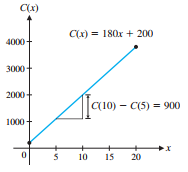
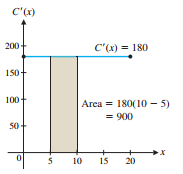
Comparing Change in Cost to Area under Marginal Cost
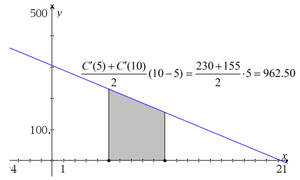
For more complex cost functions, the area under the marginal cost curve may form geometric shapes such as trapezoids. The change in cost and the area under the marginal cost function should match.
Example: For C(x) = -7.5x^2 + 305x + 625, the marginal cost is C'(x) = -15x + 305.
Calculation: The area under C'(x) from x = 5 to x = 10 forms a trapezoid, calculated as .
Result: Both the change in cost and the area under the marginal cost curve equal 962.50.
Evaluating Definite Integrals
Using Antiderivatives
To evaluate a definite integral, find an antiderivative F(x) of f(x) and compute F(b) - F(a). Antiderivatives differ by a constant, but for definite integrals, the constant cancels out.
Formula:
Choosing Antiderivative: Set the constant C = 0 for simplicity.
Substitution Techniques
When the integrand is complex, substitution can simplify the integral. Change variables and adjust the limits of integration accordingly.
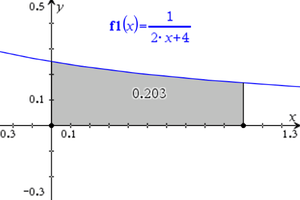
Example: Let u = 2x + 4, then du = 2dx. Adjust the limits: when x = 0, u = 4; when x = 1, u = 6.
Result: Substitute and integrate with respect to u.
Numerical Integration
When Antiderivatives Are Not Elementary
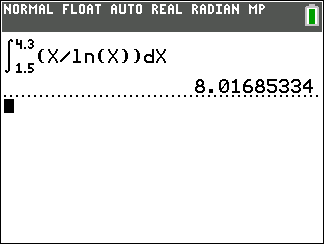
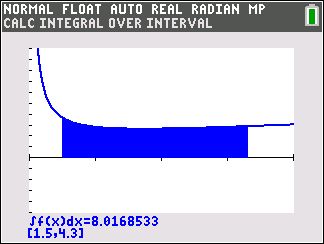
Some integrals cannot be evaluated analytically. In such cases, numerical methods or calculators are used to estimate the value of the definite integral.
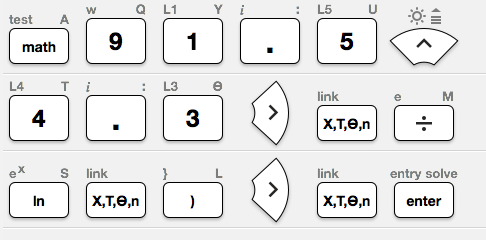
Graphing Calculator: Use built-in numerical integration functions to estimate the area under the curve.
Process: Enter the integrand and limits, and the calculator computes the approximate value.
Average Value of a Function
Definition and Calculation
The average value of a function f(x) over an interval [a, b] is given by the formula:
Formula:
Application: Used to find average cost, price, or other quantities over a specified interval.
Examples
Example 6: Find the average value of f(x) = 6x^2 - 2x over [-3, 2].
Example 7: Given the supply equation p = S(x) = 10e^{0.05x}, find the average price over the interval [25, 35].
Summary Table: Fundamental Theorem of Calculus Applications
Concept | Formula | Business Application |
|---|---|---|
Definite Integral | Area under cost, revenue, or demand curves | |
Marginal Cost | Rate of change of cost; area under gives total change in cost | |
Average Value | Average cost, price, or other business metrics | |
Numerical Integration | Calculator or numerical methods | Estimating integrals when antiderivatives are not elementary |
