 Back
Definition and Graphical Interpretation of the Derivative in Business Calculus
Study Guide - Smart Notes
 Tailored notes based on your materials, expanded with key definitions, examples, and context.
Definition of the Derivative
The Tangent Line
The tangent line to a function f at a point (a, f(a)) is a straight line that touches the function at only that one point. It represents the instantaneous rate of change of the function at that point.
Slope of the Tangent Line: The slope at x = a is given by the limit: If this limit exists, the tangent line exists at that point.
Approximation: The tangent line at x = a is a good local approximation of the function near x = a.
Example: Slope of Tangent Line
For f(x) = x^2 + 2 at x = -1:
Find the slope using the definition above.
Find the equation of the tangent line using the point-slope form.
Application: Rate of Change in Real Contexts
The derivative can be used to measure how a quantity changes with respect to another. For example, the rate at which the risk of chromosomal abnormalities in a child increases with the mother's age.
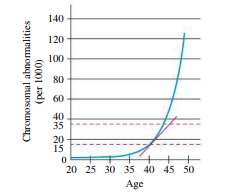
Interpretation: The slope of the tangent line at age 40 gives the rate at which risk is rising at that age.
Formal Definition of the Derivative
Derivative at a Point
The derivative of a function f at x is defined as:
If f'(x) exists, f is said to be differentiable at x.
The process of finding f'(x) is called differentiation.
Example: Derivative of f(x) = x^2
Find f'(x) using the four-step process:
Find f(x + h).
Simplify f(x + h) - f(x).
Divide by h.
Take the limit as h → 0.
Calculate and interpret f'(3) as the instantaneous rate of change at x = 3.
Example: Derivative of f(x) = 2x^2 + 4x
Find f'(x), f'(2), and f'(-3) using the definition.
Example: Derivative of f(x) = 4/x
Find f'(x) using the limit definition.
Example: Application to Cost Function
Given C(x) = -0.005x^2 + 20x + 150 for 0 ≤ x ≤ 2000, find the rate of change of cost when 100 and 1000 calculators are made.
Compute C'(x) and evaluate at x = 100 and x = 1000.
Example: Tangent Line to f(x) = 4/x at x = 2
Find the equation of the tangent line using the derivative at x = 2.
Existence of the Derivative
Conditions for Existence
Exists if:
Function is continuous at the point.
Function is smooth (no sharp corners).
No vertical tangent line at the point.
Does not exist if:
Function is discontinuous.
Function has a sharp corner.
Function has a vertical tangent line.
Graphical Differentiation
Graphing the Derivative
Given a graph of a function, the graph of its derivative represents the slope of the original function at each point. This is especially useful in economics and business for understanding marginal changes.
Key Point: When graphing a derivative, you are graphing the slope of the original function, not its y-values.
Example: Estimating Derivatives from Data
For temperature as a function of altitude, estimates of the derivative at various points can be tabulated:
h | T'(h) |
|---|---|
500 | -0.01 |
1000 | 0 |
2000 | 0.02 |
5000 | 0 |
7000 | -0.01 |
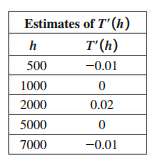
Interpretation: Positive values indicate increasing temperature with altitude; negative values indicate decreasing temperature.
Example: Production Function and Marginal Production
The marginal production curve is the derivative of the total production function. By comparing the graphs, one can verify the relationship and interpret economic meaning, such as diminishing returns.
Example: Identifying Function and Derivative from Graphs
Given two graphs, use the slopes to decide which is the original function and which is its derivative.
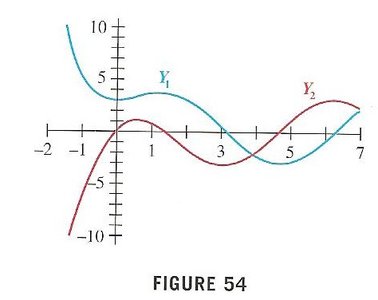
Key Point: Where the original function is increasing, its derivative is positive; where it is decreasing, the derivative is negative.
Summary Table: Existence of the Derivative
Condition | Derivative Exists? |
|---|---|
Continuous, smooth, no vertical tangent | Yes |
Discontinuous | No |
Sharp corner | No |
Vertical tangent | No |
Conclusion
The derivative is a fundamental concept in business calculus, providing a precise measure of instantaneous change. Understanding its definition, graphical interpretation, and conditions for existence is essential for applications in economics, production, and cost analysis.
