 Back
BackDerivatives of Exponential and Logarithmic Functions: Business Calculus Study Guide
Study Guide - Smart Notes
 Tailored notes based on your materials, expanded with key definitions, examples, and context.
Derivatives of Exponential and Logarithmic Functions
The Derivative of
The exponential function is fundamental in calculus, especially in business applications involving growth and decay. The process of finding its derivative relies on its unique properties.
Key Point 1: The derivative of is $e^x$ itself.
Key Point 2: The power rule does not apply to ; instead, use the definition of the exponential function.
Example: If , then .
Caution: When using calculators or technology, ensure you use the designated for the exponential function.
Four-Step Derivative Process for :
Find
Find
Divide by :
Take the limit as :
Review of Properties of Logarithmic Functions
Logarithmic functions are the inverses of exponential functions and are widely used in business calculus for modeling growth, decay, and other phenomena.
Key Point 1: For and , is equivalent to .
Key Point 2: The domain of is ; the range is .
Key Point 3: The domain of is ; the range is .
Example: is the common logarithm; is the natural logarithm.
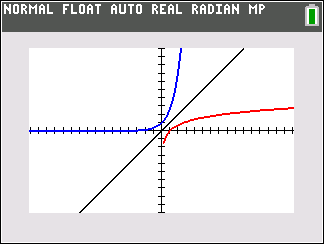
The graphs of and are symmetric with respect to the line .
Derivative of
The natural logarithm function is essential in calculus. Its derivative is derived using properties of logarithms.
Key Point 1: The derivative of is for .
Key Point 2: Use logarithmic properties to simplify expressions before differentiating.
Example: If , then .
Four-Step Derivative Process for :
Find
Find
Divide by :
Take the limit as :
Examples: Finding Derivatives
Example (A): Derivative:
Example (B): Rewrite using logarithm properties: Derivative:
Other Logarithmic and Exponential Functions
While the base is preferred in most applications, other bases may be used. Derivatives of and can be found by expressing them in terms of natural logarithms and exponentials.
Key Point 1:
Key Point 2:
Change of Base for Logarithms
To relate logarithms of different bases, use the change of base formula:
Key Point:
Example:
Change of Base for Exponential Functions
Exponential functions with base can be rewritten in terms of :
Key Point:
Example:
Summary Table: Derivatives of Exponential and Logarithmic Functions
Function | Derivative |
|---|---|
Examples: Applications in Business Calculus
Exponential Model: Price Demand Equation
In business, exponential models are used to describe price-demand relationships. For example, if , the rate of change of price with respect to demand can be found using derivatives.
Key Point: The derivative gives the rate at which price changes as demand changes.
Example: When , the price per set of strings is decreasing at a rate of about 2 cents per set.
Continuous Compound Interest
Continuous compounding is modeled by exponential functions. The instantaneous rate of change of an investment is found using derivatives.
Key Point: ;
Example (A): After 2 years, the account grows at per year.
Example (B): When the balance is , the rate of change is $800$ per year (4% of the balance).
Logarithm Model: Franchise Growth
Logarithmic models are used to describe growth over time, such as the number of franchise locations.
Key Point: models the number of locations.
Example: In 2028 (), locations.
Rate of Change: ; locations per year in 2028.
